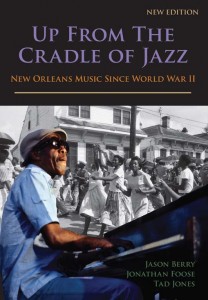
“The history of New Orleans in the wrenching aftermath of Hurricane Katrina can be telegraphed in one sentence. Politics failed, culture prevailed.” Jason Berry uses this thought to start “Memory of the Flood,” a new chapter added to the reprinted Up From the Cradle of Jazz, the history of New Orleans’ R&B generation written with Jonathan Foose and the late Tad Jones and first published in 1986. For this edition, he has added a new introduction, a chapter that moves swiftly through the ’80s and ’90s, and “Memory of the Flood,” which underscores the lesson New Orleans always knew but remembered after Katrina— that communities can only count on themselves.
On the night of May 13, 2008, Dr. Michael White unfurled a lyrical clarinet solo on “What a Friend We Have in Jesus,” backed by the Hot 8 Brass Band, in the Jazz & Heritage Foundation’s reception hall on North Rampart Street. Wearing dark slacks and a blue button down shirt with white stripes, White cut a professorial image in sharp contrast to the guys seated behind him in T-shirts emblazoned with insignia of the Hot 8. Three young players wore dreadlocks. Another sat in a wheelchair.
The irony of appearances was not lost on the three dozen people drawn to a rare evening of performance, laced with commentary about music and state of the culture. White had just released a new CD, Blue Crescent. Most of the songs were original compositions to push the threshold of an idiom many people consider static, its boundaries set and closed by the likes of Jelly Roll Morton and Louis Armstrong.
The Hot 8 had been steeped in funk, and a hard-charging street style long on rhythm and short on melodic polish, a groove popular with hip-hop fans. Since Baty Landis and Lee Arnold had gotten them to work with White, the Hot 8 was developing a stronger sense of melody, a reach back in time to a style that all but bypassed them in the 1980s as they moved through public schools and street gigs in a milieu where brass bands competed with rap as the soundtrack of street life. “Jazz is a way of life and there are many lessons that apply,” White began. “The blues and hymn styles played by the early brass bands came about originally when jazz was dance music.”
White stood at a podium behind a photograph of the late Tom Dent, the poet and historian who served as Jazz & Heritage Foundation president in the 1990s. “New Orleans jazz was functional,” he continued. “They played it for picnics and parades of the social and pleasure clubs. Jazz was a voice of the African-American community seeking freedom.”
The musicians seated behind White had taken traumatic hits that held a mirror to the city’s jagged social divide. A large oak-shouldered tuba player named Bennie Pete founded the Hot 8 in 1995. In 1996 the band’s trumpeter Jacob Johnson was murdered in a home robbery that netted his killers $40. Trombonist Joe Williams was shot dead by police in 2004 when he failed to heed orders to stop the car he was driving, unarmed. NOPD claimed it was stolen, a charge disputed by Williams’ friends. The band was still recovering from the murder of Dinerral Shavers, in early 2006, when trumpeter Terrell Batiste (not directly related to Alvin) was struck by a car in an accident near Atlanta, which led to the amputation of his legs above the knee.
Batiste sat in a wheelchair wearing shorts, holding a trumpet. Seated around him were Henry Cook on bass drum, Samuel Cyrus on snare, Bennie Pete gripping a large sousaphone, trumpeter Greg Williams, trombonist Gregory Veals, and tenor sax man Wendell Stuart.
“Today we have problems in education,” said White.
Heads nodded at the oblique reference to turf wars in high schools.
“Jazz can have uplifting effects on young people,” White said soothingly. “There’s a positive influence that comes with participating in school bands, learning the value of teamwork. It’s a lot easier to become a member of a band than make it to the Hornets.”
Few public schools had solid band programs before Katrina, and apart from NOCCA there was scant instruction on the fundamentals or history of jazz in the combined Recovery, Charter, and Orleans Parish school districts. The environment for at-risk youth in New Orleans was better in 1913, when Louis Armstrong was sent to the Colored Waif’s Home, than in 2008.
White introduced “Bye and Bye,” one of the church hymns popularized by the brass band musicians in the parades of early jazz. If you’d conducted a blindfold test on identifying who was playing the song that night, White’s swirling clarinet lines might have registered with people familiar with his sound. Who would have recognized his accompanists? In that post-Katrina funeral parade for chef Austin Leslie, the band sent out smoking section riffs, repetitive rhythms as they swaggered along in a dead city. What a contrast with the sweet rolling harmonies of a church groove as they played with White in a medium tempo melody, Bennie Pete’s sousaphone purring like a bullfrog in swamp bottom.
The Hot 8 sounded downright beautiful.
This excerpt of Up From the Cradle of Jazz is from the new edition, published earlier this year by University of Louisiana at Lafayette Press.