Rik Slave moves like a marionette. The lead singer for Rock City Morgue is onstage at One Eyed Jacks dancing like his arms and legs are on separate strings from his torso. To his right is guitarist Johnny Brashear, muscling out riffs from a few generations of metal, hard rock and punk, but it’s hard to look away from Sean Yseult on the other side of the stage. It’s not that she’s crazy rocking; it’s that she’s not. Sitting behind her piano with her blonde mane and black pinstriped vest, she’s relatively still in the midst of all the sound, her face implacable. When she leaves the piano and picks up her coffin-shaped bass, she moves precisely, holding her bass in a way that would make her music teacher proud as the tuning head points to 2 o’clock.
Yseult’s been in New Orleans since 1996 and has had two bands here—Famous Monsters and Rock City Morgue—but most of the world knew her first as the bass player for White Zombie. What only those who followed White Zombie since its inception know is that the band started in art school. Because “art school band” evokes images of wealth and Talking Heads more than a heavy band, “White Zombie didn’t want people to know, but we definitely were,” she says. “We met at Parsons (School of Design in New York City). Rob and I met and started the band. Our first drummer, Peter Landau, was a Parsons design student. Our first guitarist was Ena Kostabi, who was the little brother of Mark Kostabi, a famous artist. When Ena left, we got Tim Jeffs, who was an illustration major at Parsons, and when he left we got Tom Guay who was also at Parsons.” Yseult was there for photography and graphic design, and has remained active as a visual artist. She has shown a number of times in galleries on Julia Street, and she opens a new show with fellow Raleigh, North Carolina native Louis St. Lewis Saturday, November 7, at Canary Gallery on Julia Street.
During White Zombie days, she did silk-screened posters and album art, and she has done the artwork for Rock City Morgue, including their Some Ghouls EP, with a cover that mimicked the Rolling Stones’ Some Girls, but with famous monsters’ faces instead of starlets. “I enjoy working with typography and photos,” Yseult says. “I started as a photo major, but the tediousness of the darkroom drove me mental.” On the cover of the band’s new album, The Boy Who Cried Werewolf, she gives a Warhol treatment to a black and white still of a werewolf, and she shot photos of band members Slave, Brashear and John Gray in black and white poses that suggest they’re inhabitants of the house from Dark Shadows.
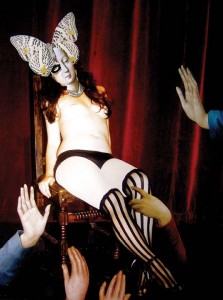
Much of her art today is based on photos. One Eyed Jacks has portraits that she shot and St. Lewis manipulated that were then transferred to vinyl albums. The front dining room in La Crepe Nanou features three light boxes that she made—black and white photos on Plexiglas of women shot seemingly without their knowledge, then lit from behind and bordered with heavy red curtains, giving each piece a theatrical quality. The “play” motif makes sense because Yseult cast her friends as the damsels in the photos; Jennifer Kirtland of Hazard County Girls and Katie Campbell of Famous Monsters are two of the women in La Crepe Nanou, and one from that series featuring Hazard County Girls’ vocalist Christy Kane hangs in Yseult’s house. For the new series, Yseult returns to a similarly detached aesthetic, photographing burlesque dancers on the One Eyed Jacks stage, letting its more worn elements take the glamour out of the photos. Her inspiration was the famed Storyville photographer E.J. Bellocq.
“When I moved to New Orleans, there was a huge Bellocq exhibit at NOMA, so I rode my bike up Esplanade, went to that show and was blown away,” Yseult says. “I’d known of them before, but I’d never seen the prints like that. There’s a creepy timelessness to them, and especially the ones with the scratched-out eyes.”
The control in Yseult’s stage movements extends to her art, and only her history with Louis St. Lewis dating back to Raleigh makes it possible for her to hand over her photos. “He was the bad boy of art school at the time, he and Dave LaChapelle.”
When she shows jpegs of the pieces on her computer, she shows the photos she shot and St. Lewis’ treatments, which range from a woman seemingly stuck in an endless wave dissolve, to women with new parts and decorations attached to them. Some of her photos will be affixed to the backs of mirrors with only some of the silvering scraped away, leaving the largely nude women defined by the reflective material around them.
“We’re going to have a number of large pieces in this collection, along with the mirrors that are going to be around 16 by 20,” she says. “I was trying to restrain Lewis by some format. As a graphic designer, I like a little rigidity.”