Gretna Heritage Festival 2010

Music from Thin Air

bobbyskinner

Photo by Elsa Hahne

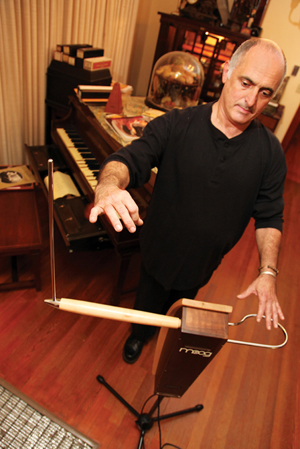
Playing the theremin transforms Bobby Skinner’s entire body into an instrument. “I am part of an electronic bubble,” he says, “pulling pitch with the right side of my body while my left side manipulates the notes.” He conjures music through a ballet of hands, fingers, and arms, and the body movements are not arbitrary since the theremin reacts to the proximity of the player’s body to its two metal antennae situated at either end of the instrument. Anyone attending the Louisiana Philharmonic Orchestra’s rendition of the Little Mermaid on October 29 would have seen this strange and magical undulation as Skinner plucked notes like dreams from air.

There is no touch involved when playing the theremin, no frets to guide, no keys that lead the player directly to a given note. It’s a purely electronic instrument, and its sound is derived from the two oscillators and antennae that generate electricity, and their physical proximity to the human body. It is quite simple to make sounds with a theremin; anybody can do it. It is quite a different matter to organize these sounds into recognizable notes, and it requires an investment of several years to master this instrument skillfully enough to play it in an ensemble.

The position of the hands when playing the theremin is as individual as the players themselves. There are generally accepted rules but no standardized finger arrangement as you would find on a guitar or piano. Skinner prepares to play by forming one hand into an “ok” configuration. He also admits that playing the first note to match the key signature in any ensemble requires both acumen and “a leap of faith.” If the first note is muffed, experience and a good ear allow him to quickly adjust. Once he locates the right pitch in the key signature, muscle memory takes over. Skinner explains that he can visualize in thin air where the proper pitch is once he’s tuned in to the first note, and he compares that fraction of a second when he is locating the precise pitch to a trombone player or a violinist who will make use of portamento—a quick, discreet adjustment of the fingers to the right pitch, which sounds like the note is briefly gliding.

Skinner already had a penchant for arcane musical instruments. He had been storing and refurbishing automatic music instruments, like player pianos, before he ever encountered his first theremin. He knew enough about the instrument to know that it was responsible for all those kitschy sound effects in B-movie science fiction films from the 1950’s, but his formal introduction to the instrument would come indirectly, through a friend.

“A friend named Rita Lovett, who lived in Milwaukee, had heard an old 78 recording called “Music from the Moon,” which she thought was strange enough to send me, and when I listened to the 78s, which were from the 1940s or 1950s, it was like lounge music.” But it had an effect on him. “I thought the instrument would be a challenge,” Skinner says. “When I first started playing, I would put in a roll sheet in the player piano and play along with that.”

From his early days of collecting musical oddities, he had graduated to an intermediate level of playing one of the oddest of instruments. His repertoire grew as he added Gershwin to his list of composers he would accompany alone. And he added other genres, other artists. “It took about a year until I was finally comfortable enough to play with groups.”

When he entered the University of New Orleans in 1998, he gained a fuller understanding of the intricacies of the instrument and of music itself. He is now a sought-after musician whose abilities allow him the latitude to play anything from symphonic pieces to jazz or country. When speaking about the theremin, he often refers to its approximation of the human voice. Skinner touts Lera Auerbach, the composer of the Little Mermaid, as one of best composers to write music specifically for the theremin. In the Little Mermaid symphony the theremin assumes the voice of the mermaid, and it’s this affinity for replicating vocal melodies with the instrument that continues to stoke his interest in its possibilities. Patsy Cline’s melody in “Crazy” is another favorite of his.

Bobby Skinner’s true musical home is now with The New Leviathan Oriental Fox-Trot Orchestra. Listening to them in a strippeddown upstairs room on Julia Street it’s easy to see why. New Leviathan is about freedom. It’s a mix of Dixieland, ragtime, and jazz-inspired spontaneity. The group played several numbers, and there was an acoustical aspect to the room that was sweet but incomplete until finally Skinner conjured sound like a sorcerer. Then, the wood floor vibrated until the last notes left through the half-opened windows.

  1. Pat Jjessee says:

    That orchestra is magical- the feelings they create when playing full out is amazing and memborable fo all who here it and dance with it. This addition to their cadre of instruments is PERFECT- off beat- and intriguing to the ear- but friendly to your soul….

Leave your own Comments

blog comments powered by Disqus
Legendary Rhythm and Blues Cruise