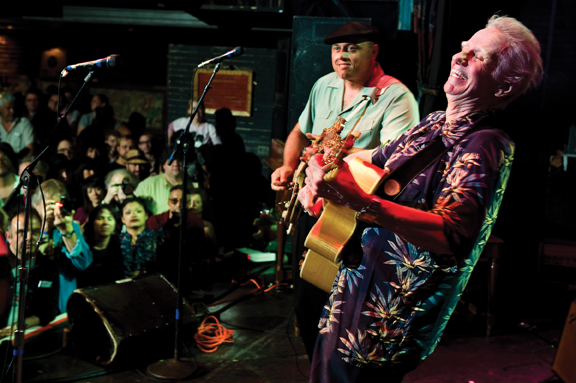
2010 isn’t turning out to be a very good year for legendary Louisiana rock ’n’ rollers. Just last month we reported on the passing of Bobby Charles. Sadly, this month we must pass on the news of Dale Hawkins’ death on February 3. Hawkins died at a hospice facility in his adopted hometown of Little Rock, Arkansas, after losing a prolonged battle with colon cancer. He was 73. A semi-frequent visitor to New Orleans, Hawkins was a regular participant at the Ponderosa Stomp.
Ironically, Hawkins and Charles’ early careers had many similarities. Both had identifiable hits during the early days of rock ’n’ roll, and they both recorded for the same Chicago record company, Chess. They were also prolific songwriters. In Hawkins’ case, his defining recording was “Suzie Q” in 1957, a recording about which author Colin Escott stated, “Never had a white person sound so crazed on a record before.” It also made the Rock and Roll Hall Fame’s list of 500 songs that changed rock and roll.
Born Delmar Hawkins August 22, 1936 in Gold Mine, Louisiana, he was the cousin of another rockabilly legend, Ronnie Hawkins. His family eventually moved to Bossier City which is located across the river from Shreveport. The proximity of the Louisiana Hayride made country and western music accessible, but Hawkins also had an uncanny ear for blues and R&B music.
“I got a job working at Stan’s Record Shop (mid-1950s) when it was still a little-bitty place,” recalled Hawkins in 1989. “I got to listen to all the new blues records because that’s all Stan sold. It got to the point where people would come in the shop and hum a few bars of a song and I knew what record they wanted.”
By night, Hawkins had a rockabilly band that found ample club work on the notorious Bossier-Shreveport highway strip. Hawkins recruited a talented 14-year-old guitarist, James Burton, who often had to sneak into clubs because he was under-aged. With the help of his boss Stan Lewis, Hawkins landed a deal with the Checker label.
“My first record was ‘See You Soon Baboon,’” Hawkins said. “At the time Bobby Charles had a record out, ‘Later Alligator.’ My song wasn’t in the same league as Bobby’s, but we hoped it might get some attention. We recorded it at (Shreveport’s) KWKW studio and Stan sent a dub to Leonard Chess. He put it out and then came down to meet me.”
Hawkins second record, “Suzie Q,” was also recorded at KWKH and would change his life.
“I wrote that song around the guitar lick,” said Hawkins. “We were playing it in the clubs for a long time and the song gradually developed. We added a cowbell and drums on the intro. After the solo, we went to the four rather than the two which was unusual. James was really a country picker, but I made him listen to blues records. That’s how he got that bluesy sound on ‘Suzie Q.’”
As the record soared in the charts, Hawkins hit the road working a series of one-nighters and appeared on American Bandstand. He continued to record for Checker until 1961, but couldn’t repeat the success of “Suzie Q” despite some good attempts.
In the early 1960s, he hosted a variety TV show in Philadelphia and hopped from label-to-label without much success. By the mid- 1960s, Hawkins and his pregnant wife moved back to Shreveport where he was reunited with his old boss Stan Lewis. Lewis had started up Jewel and Paula Records, and hired Hawkins as a producer and promotions man. While in Shreveport, Hawkins was responsible for signing John Fred as well as producing hits for the Uniques.
By 1968, Hawkins had moved to Dallas, where he produced Bruce Channel and the Five Americans for Abnak Records (There is a riotous section in Don Nix’s book Road Stories and Recipes, concerning this period of Hawkins’ life.). Ironically, 1968 was also the year Credence Clearwater Revival had a hit with their cover of “Suzie Q.” The following year, he cut an album for Bell titled LA, Memphis and Tyler, Texas.
After battling an addiction to prescription drugs for decades, Hawkins settled in Little Rock to be near family and a rehab center. He overcame his addiction and became a councilor at that rehab center. He also opened his own studio in Little Rock in the mid-1990s initially to record other artists. In1999, he recorded the
highly acclaimed Wildcat Tamer CD which appeared on Mystic Music.
During the last decade Hawkins continued to make festival dates here and abroad, even after being diagnosed with cancer.
He was buried in Little Rock.