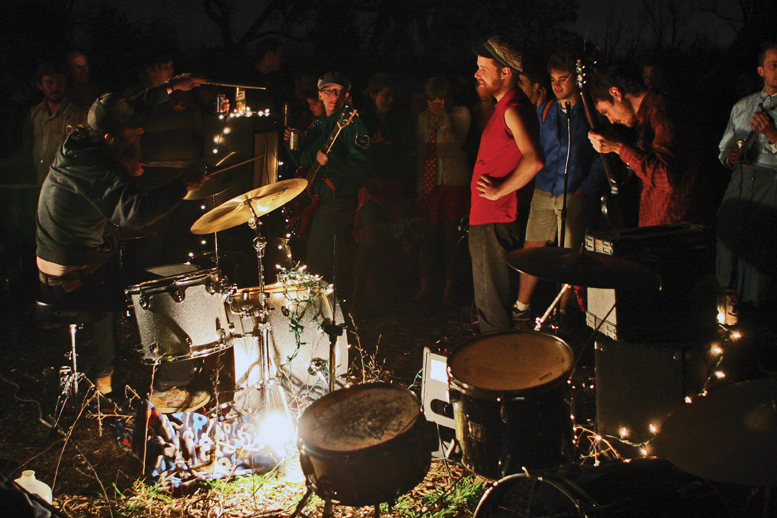
It was the most safe I ever felt in a pitch-black abandoned warehouse out by the train tracks. All I could see were silhouettes out the door against the foggy outline of the Crescent City Connection. All I could hear were the murmurs of the crowd and the occasional train horn.
Suddenly, the puttering of the diesel generator resolved into the steady purr of flowing electricity. The lights flickered on again, accompanied by the cheers of the crowd. The touring hardcore band picked up their instruments and tore into another song as the crowd converged on them at the front of warehouse again, shouting and slam dancing.
It’s not your ordinary show; it’s not even the most inventive live show you’ve seen at the most hip venue in town. Beyond the traditional bars and clubs, there are a slew of young entrepreneurs honing their visions for the live show. Through the use of guerilla organizing and marketing reminiscent of the early UK rave scene, these entrepreneurs are making their mark on New Orleans by bringing shows to public parks and other unused spaces in order to “get music out of its hole in the Bywater,” as one organizer put it.
Towering court trumpeters, flittering golden angels, and one particularly creepy goblin kept watch over Giant Octopus’ first event in Mid City last December. The arts and music show, aptly titled “Beer—Music—Art,” took over Studio 3 on Toulouse Street, a crafts warehouse filled to the brim with carnival sculpture.
The show was the first in an array of planned happenings from the young creative team of locals Ingrid Anderson, 23, and Devin Morgan, 21. Under the production name “Giant Octopus,” the duo has been planning one-night arts events in anticipation of opening their own venue and arts space.
Morgan once managed his own venue in St. Bernard Parish in 2005 called the Goondocks, but it was washed away along with the rest of the parish during Katrina. In recent years, he has worked at Tipitina’s and the House of Blues in sound and promotion and as a stagehand.
Anderson studied art at Loyola University, has a degree in advertising and says that the small crowd in New Orleans lends itself to easy networking. She also interned at Berning Marketing, a Metairie marketing firm, and has been DJing regularly at Café Prytania. When I met with the two over pizza Uptown, Morgan rolled in on his motorcycle, his sleeves high enough on his arms to reveal his “Where the Wild Things Are” tattoo, while Anderson biked to the meeting, her dreadlocks perhaps a little heavy to exactly blow in the wind.
Giant Octopus’ “Beer— Music—Art” was a success, drawing a crowd of 75 paying guests on a glacial December night. Patrons were greeted by Studio 3 proprietor Jonathan Bertuccelli’s larger-than-life statuary, several art exhibits, allyou- can-drink beer, and a full night of music and DJs.
Local visual artists displayed painting, photography, installation art, and mechanical art in the gallery area near the entrance, and bands played in front of a giant carnival mask backed up by an elaborate lighting setup. Featured musicians included Maddie Ruthless, Toast Beards, Booty Trove Brass Band, and Caddywhompus. With the exception of Luling-based Toast Beards, most musicians came out of the music scene at Loyola University, of which Anderson is an alumna and Morgan is a student.
“I think anyone who showed up was really impressed with the space. They weren’t expecting it,” Morgan says.
While the team ended up losing $27 on the show, they consider it a strong start, and have started working on their next events. On the table right now are a March show at the Candle Factory in the Bywater and a tattoo-themed show in May at One Eyed Jacks.
“I think it’s better to have shows in studios and places that don’t already have a name for themselves,” Anderson says.
“Otherwise people will think it’s just another show,” Morgan agreed.
The team’s real goal is to open up their own space, a so-called “artists community center.” Morgan likened the concept to the Zeitgeist Multi- Disciplinary Arts Center and the Big Top, except even more inviting and open to the community. Anderson drew parallels between their venue and the NOLA Art House, an embattled arts and events space and residence on Esplanade Avenue with a backyard known for its elaborate tree house. In recent months, the Tree House has become mythic among the university and young professional crowd across South Louisiana.
“It’s the most creativity and art I’ve seen anywhere. You’re not just going to an art gallery or a music show; it’s a place like you’ve never seen before. I think what they’re doing is great,” Anderson says.
The team acknowledges the difficulties in setting up such a business. The biggest issue right now is funding. The two are looking into loans and Anderson is seeking grant money for women entrepreneurs.
“We’re not businesspeople,” Morgan says. “We’re not trying to get rich, we’re just trying to support the artist community and make a living. We have lots of good ideas, lots of love, and I think people will respond well,” Morgan says.
“I see bar shows as going to a store, while going to a generator show is like going with your friends to a picnic,” said Jackson Blalock, 24, local musician and show organizer.
The so-called “generator show” takes its name from the diesel generator that is used to power the event. Once liberated from the power grid, an entire show complete with PA system, amps, lighting, and more, can travel to the most exotic locales, offering audiences a unique experience for each show.
Although generator shows have been occurring in music scenes for years, Blalock has found that the natural and industrial topography of New Orleans offers some stunning atmospheres.
I spoke with Blalock, with his mop of ungovernable red hair, at the Mid-City squat that he and his roommates are fixing up. He runs an independent cassette label and distribution service called Wealth and Physical Stamina, but he got his start in organizing shows as a result of his career in New Orleans bands over the past two years. His bands favored playing house shows because of both the freedom and intimacy they offer, but such gigs are rare.
“There aren’t house show spaces, but there are a lot of other spaces around town that aren’t being used. Abandoned industrial sites and public spaces,” Blalock says. “Generator shows are a way of activating those dead spaces.”
Venues for such concerts have included old warehouses, the roofs of flooded-out buildings, and tucked-away corners of public parks. Last summer, a number of local and touring bands played in what appeared to be an old Spanish mission town out West. In reality, it was an abandoned movie set in the middle of City Park. The environment, with glowing candles, strings of Christmas lights, and a working bell tower provided a slightly surreal and definitely compelling backdrop for the show.
“Everybody who has been involved has been aware of their surroundings and likes to know the different aspects of the city,” Blalock says. “It’s like, ‘Hmm, what can we do with this spot?’”
The nontraditional venues for the shows bring challenges. There is a balance to maintain between drawing a crowd and respecting the show space and its neighbors. Cops have shown up to shows, but once things have been explained to them, there usually is no further problem. None of the shows with which Blalock has been involved have drawn any further scrutiny from officials.
“You gotta have respect,” Blalock says.
Generator shows in New Orleans draw crowds in the dozens, sometimes upwards of 75 to 100 people for larger ones. Blalock sees why some people may have trepidation over coming out to a show, but he does not necessarily see it as a problem.
“A plus is that generator shows are outside of some people’s comfort zones, and it actually pushes people,” Blalock says.
It’s not only the location, but also the means of advertising that stop some from attending. Shows are often advertised not with a physical location but with a phone number to call for the location. This is for practical reasons as much as for secrecy. It gives organizers the time they need to scope out several spots, and the opportunity to change the location suddenly if anything falls through.
“An element of a generator show is its secrecy,” Blalock says.
Because extra effort and trust are required on the part of the audience, the crowd that does show up is usually very enthusiastic. For shows in which Blalock is personally involved, locations are rarely repeated, so it’s always a new experience. It’s also music for the sake of the music and the community.
“It’s music outside of the capitalist context,” Blalock says. “One of our main goals is to not have anything to do with money. It’s a good time anyone can come to whether they have the $5 cover or not.”
Dan Helfers has been booking shows for seven years, and he’s only 23. Recently, he seems to have struck gold with his Electronic Takeover shows, just one branch of an intricate tree of music business projects in which he is involved.
Helfers, who has a degree in business administration with an emphasis on music business from Loyola University, has his own recipe for success: strong, targeted marketing and managing, combined with killer shows. It’s working.
“I just graduated, and I chose not to apply for jobs,” Helfers says.
Instead, he has been busy forming his media marketing company, managing burgeoning local acts, covering and promoting the scene with his “DeftJams” blog, and producing parties. His mission is to nourish the electronic music scene in New Orleans.
His biggest success to date is his electro party Electronic Takeover, which he produces with Max Braun and Chris Rengel, who DJs the party under the name Swiss Chriss. The show, which is presented at the The Maison on Frenchmen Street, garnered 240 guests for its last iteration in 2009, and 350 guests for its first show of 2010.
The show takes over the loft at the Maison. Helfers likens the environment to a house show, as the loft is essentially a three-bedroom apartment. One room features DJs and an elaborate lighting show, while a “chill room” offers couches and a giant projector screen. A recent show featured scenes from BBC/ Discovery Channel’s Planet Earth while DJs were spinning in the adjacent room. There is always a new aspect to every show.
Helfers is extremely aware of the balance required between his show and the way he markets it.
“We literally sit together all day and brainstorm on how to make this the best electro party New Orleans has ever seen—or will ever see,” Helfers says. “We have to make sure each event is going to be better than the last event, fresher than the last event. And there’s no exceptions.”
To this end, Helfers uses his Future Vice marketing business, which he runs with Braun, to promote shows and manage talent. His DeftJams blog covers the aftermath with photography, track samples, and show updates. Helfers and Braun also personally manage Swiss Chriss and DS@STR, who perform at Electronic Takeover. It’s a finely tuned, vertically integrated music business plan.
Helfers looks to successful local venue proprietors for inspiration and calls Robert LeBlanc “one of the best people in NOLA.” LeBlanc is founder and CEO of Lifestyle Revolution Group, which owns Republic. Helfers credits his nightlife entrepreneurialism and risk-taking as “something we really need” in New Orleans.
Helfers is enjoying the success of his projects and hopes to develop DeftJams into a nationally known music blog. It all hinges on the synergy between good talent and good business.
“I just want it to be fresh. If we can build something more sustainable, and the kids trust us, and we know we’re putting on good shows, that’s where I want to be,” Helfers says.
Community is at the core of every success story in New Orleans. Our young music entrepreneurs and aficionados have seen this and tailored business plans to also be community plans. When the lights go out—and they will sometimes—the show may be delayed, but that’s not the only reason we’re here. It’s about the event. It’s about the community. And we’ll have a lot more to talk about tomorrow than just the music.