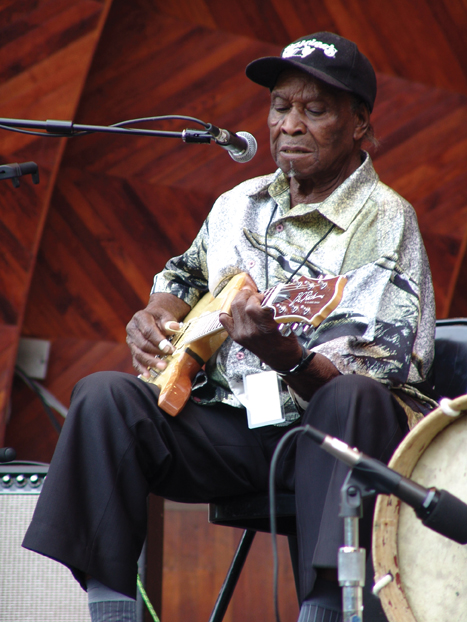
It’s not every day that an interview subject slips his hand under his pillow and slides out a pistol. “When you got money,” 95-year-old blues musician David “Honeyboy” Edwards says, unclipping and reclipping the magazine of his .38, “it’s good to be on your cues.”
More than 70 years ago, just before the Depression, a teenaged Honeyboy—who’ll play the Ponderosa Stomp September 24 and 25—left home to travel with Big Joe Williams, right on through to the 1950s when Edwards settled in Chicago. In the years he lived as a hobo and hustler he shook hands with some of the first recording artists, including Son House. He knew Robert Johnson and was with him the night he was poisoned by a jealous husband. His first visit to Chicago was in 1946 with 15-year-old soon-to-be harmonica giant Little Walter, and on subsequent visits he would be in the middle of the Chicago electric blues scene that begat Muddy and Buddy.
Today Edwards is recalling the almost 30 years he spent as a hobo.
“I’d ride freight trains,” he says. “I’d see the brakeman hook up the carbox, and hang around in them bushes and wait. When the train’s hooked up, I’d see the brakeman throw the lantern up to give the engineer the signal, then I’d ease on down there and jump in.”
When the railroad cops were particularly enthusiastic, there was always “riding the rod.”
“You lays crossways between two steel rods that ran beneath the undercarriage,” he says. They’re large enough that you can get your rest if you want to.” But the system was not without drawbacks. “Sometime a train run so fast that rocks would jump up and hit you.”
Being used to the heat of the South, Edwards keeps the thermostat in his South Side apartment cranked up high. He has accumulated very little over the years—some mementos and statuettes given to him by blues societies as well as a few blues CDs, also gifts. The photographs that line the walls of his bedroom are also framed in “traveling light” fashion—mounted to cardboard backing and covered with Saran Wrap. There is also a large poster of Charley Patton, who died when Edwards was 19—the one thing framed in glass. Everything seems like it could be packed in an hour if need be.
“The best way to ride if you want to go a long ways hoboing,” Edwards says, “is to get in a carbox and spike it from the inside.” Which leads to the first lesson in hoboing: always carry a clean newspaper to lay on and look for a railroad spike to jam the door shut with. “If you pull into a station and have a bad railroad cop, it doesn’t matter how much he pulls and rocks the door, he can’t get in.”
Though the young-faced Edwards is no longer nimble enough to shimmy up the side rungs of a moving train to sit on the roof (“You got to watch out for them tunnels”), his mind is still razor-sharp, and he is blessed with an almost perfect recall of names, dates, places and events from the distant—often way distant—fog of time. He still rattles off colorful stories at lighting speed in a thick, fast Mississippi drawl, his words often pitching up in sharp notes of enthusiasm.
It would have been in the late ’30s that Edwards learned a lesson in a moving boxcar shooting dice game with a one-eyed fellow hobo “somewhere twixt Memphis and Tupelo,” he says. By the time the pair pulled out the railroad spike at their destination, the one-eyed hobo had all of Edwards’ money. “Now that’s a slick guy,” concedes Honeyboy. After playing music that night to recoup his losses, Edwards accepted an amorous offer from a female admirer and asked if she had room for the fellow traveler. “He slept on the floor and I slept with the girl!” Edwards says, laughing. The next morning the one-eyed hustler took Edwards aside.
“He said to me, ‘You’ve got a lot of sense, but you ain’t got enough,’” Edwards recalls. “‘I’m going to learn you something and give you a stick to walk with for looking out for me last night.’ With that, he pulled out a sock full of dice. Every one of them was crooked! He showed me how to use them, what they was, everything. From then on, I started to gambling. I’d go to a levee camp, play my guitar, make a stack then jump in the game. Sunday, I’d leave with a pocketful.”
But after a moment, he says, “I quit that shit. Too dangerous, I used to (have to) carry a gun, just like I do now.”
As he sits waving his pistol around the room, the dark and dangerous side of being a hobo comes to the forefront. Though he is now settled and a card-carrying member of the “living history” club, one thing is for sure. Edwards’ 30 years as a hobo, gambler and hustler left lessons that can never be forgotten. You can take the man out of the streets but not the streets out of the man.
A version of this story previously appeared in the Clarksdale Press Register. The full interview can be heard at SittingWith.com.