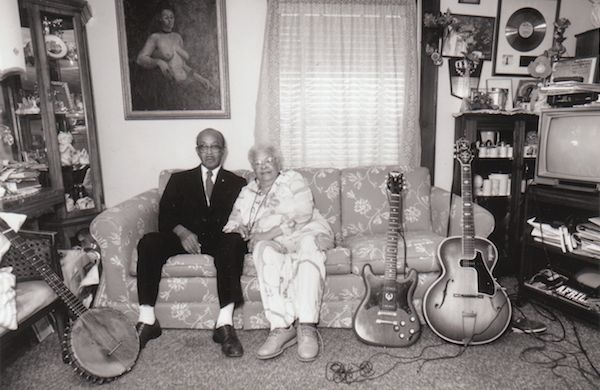
Her voice was never as buxom as she was. Her husband’s fame outgrew her own. Still, Blue Lu Barker remains an important icon of New Orleans jazz and blues 12 years after her death. And while her best-remembered material dates from the ’30s when she was living in New York City, Barker continued performing, especially after resettling in New Orleans, well into the 1980s. Some song titles? I Feel Like Laying in Another Woman’s Husband’s Arms. Loan Me Your Husband. Love that Man. I’ve Got Ways Like the Devil. Marked Woman.
On her last recording—an appearance from 1989’s New Orleans Jazz Fest not released until the year she died—Lu’s voice wears the cellophane mask of time, yellowed and brittle, yet filled with oaken substance. As she crackled on, the fans roared in approval while the band churned behind her. Age was not a hindrance. Instead, it was the rattling declaration of Blue Lu Barker’s story, her crinkling vocals a memorial to a life lived well.
Barker was the antithesis of today’s glitzy seductress. She sang with more daring suggestion than Beyonce’s plunging neckline. And while singers today rely on athletic histrionics, Blue Lu delivered the goods in a subtly timbred, high voice that told you more by what she didn’t say than by what she did. Mischief and hijinks lingered in between each pause, and the music playing behind her offered more of the same. “Onstage I say all these things, and I shake and dance,” Barker told The Times-Picayune in 1987. “It might give you the impression that I’m a bad or fast person. But if you know me you find out that I ain’t none of those things. Because I don’t even flirt. I’m not a real rowdy person. I’m a fun person.”
Her dad operated both a pool hall and a candy store, where he sold bootlegged liquor he made at home. As a kid she focused on dancing, but she was singing as early as seven years of age. Yard concerts would feature a piano, maybe a kazoo. “We’d get paid $3.50 for being in the concert, but we’d spend more than we made,” she said. The risqué persona was born out of those times, a performer’s mask to hide behind. “Mother taught me in front of the armoire…but when she was asked about it later, she said, ‘Nobody ever taught Lu anything like that in this house.’ She went to all my concerts, even tried to smoke like they did in New York. I guess you could say she was sassy,” Barker told documentary filmmaker Suzanne Rostock.
Husband Danny Barker wrote many of Blue Lu’s songs, including her most famous hit, “Don’t You Feel My Leg” (a.k.a. “Don’t You Make Me High”) but Blue Lu had a history of singing bawdy songs, her phrasing developed from her youth. “The type of blues I was singing, I was too young,” she said of her early years. “Mama said people would think I knew what I was talking about.”
In 1930, Louisa Dupont married Danny Barker. She was barely 16. They remained married until Danny died 64 years later. Her career really hit in the late ’30s when she recorded 24 sides for Decca. Her delicate voice gave the songs the right dollop of intrigue. Her voice proved a perfect foil for genius trumpeter Henry Allen’s horn lines.
Blue Lu put her career on hold when the couple moved to New York. After their daughter was born, Danny urged Lu to start singing. She took the bait, and after hearing her 1938 tryout, Decca offered her a contract. A company executive asked if she had a professional name. “I asked Cozy Cole, the drummer, what’s a professional name? He said, ‘Something short and snappy.’ So I said Lu Blue. We switched it around, added Barker, that’s how I got the name.”
The Barkers moved back to New Orleans in 1966, where Blue Lu was more than just some famous musician’s wife. She performed with Danny at Jazz Fest regularly. She appeared in movies, including Live and Let Die, and Rostock’s documentary about her, Blue Lu. And there was more to her than a mischievous turn of the phrase. “First time I heard her sing I was amazed,” jazz historian Tom Dent said. “Her performance was risqué… her actual personality was just the opposite.”
Blue Lu also recognized the importance of a jazz funeral. When her husband died, she made sure that the real traditions of jazz funerals were honored. She felt many jazz funerals had gotten away from what they were meant to be.
In May 1998 the fun was over. She received her own jazz funeral, having succumbed to natural causes at the age of 84.