Arnone Crawfest May 2013

Cover Bands: What Do You Want?

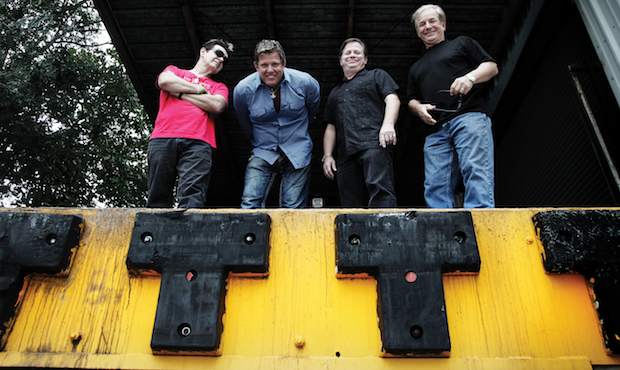
The Topcats. New Orleans cover band. Photo by Elsa Hahne.

The Topcats. Photo by Elsa Hahne.

It’s 10:30 on a Wednesday night. Rob Schulte emerges from the darkened dance floor and settles in behind his expansive drum kit. To his left and right, the other members of the Topcats are tuning up guitars and turning on keyboards. These same four friends—Schulte, William “Buzzy Beano” Langford, David Gamble, and Pat Campbell—have been playing together for going on three decades.

On the other side of the darkened bar, two dozen patrons are milling about, swilling beers and waiting for the music to begin. Schulte scans the crowd from his perch in the center of the stage and spots a group of middle-aged men wearing leather jackets and Harley Davidson bandanas on their balding heads. With a quick nod and a twirl of his sticks aimed at soundman Frank Robert, who has been hovering over the soundboard mixing the Topcats since 1983, Schulte calls out “Easy Rider” and within seconds, the opening notes of Steppenwolf’s classic-rock mainstay “Born to be Wild” begin to thump out of the stacks of speakers. The bikers let out a roar and swarm the empty dance floor. For the next three hours, the crowd swells to capacity as the Topcats serve up exactly what the audience was looking for—a high energy show serving up their favorite music note for note.

This ability to read an audience and give them exactly what they want is what Schulte believes has allowed the Topcats to become engrained in the New Orleans music scene. The Topcats have been around in their current configuration for 29 years, making them the second oldest lineup in the city after the Radiators.

“And the Radiators are breaking up,” Schulte says with a laugh. “So we win, I guess.”

Inducted into the Louisiana Music Hall of Fame in 2005, the Topcats played Jazz Fest in 2004. They have put out two albums of original material (one of which produced a single that saw heavy airplay on local radio stations), sold out the House of Blues twice, and they consistently pack in audiences in numbers any musician would envy. Still, they’re often dismissed as “a cover band,” the byproduct of the common belief that cover bands are populated by untalented musical rejects without the ability or guts to write original material, Schulte says.

“I’ve had people tell me to get lost, that they’ll pay attention to me when I stop selling out and playing other people’s music,” he says. “Elvis never wrote a song in his life. You wouldn’t say he was in a cover band, would you?”

In a town where you can walk down Frenchmen Street and hear five different “original” musicians all riffing on “St. James Infirmary”—a song they didn’t write—making the determination that the Topcats and the dozens of working cover bands like them in the New Orleans area aren’t on the same level is a hard sell in Schulte’s book.

“I always say it takes a lot more talent to be a band that has to replicate 30 different artists in a night, as opposed to an original band that can come out and just be themselves,” Schulte says. “I have to sound like J. Geils one song, and then the next song I have to sound like Nelly.”


For music producer and guitarist Jack Miele, switching from playing in a cover band to an original band requires a musical separation, but the amount of talent and hard work he puts in remain the same. In addition to recording and producing at Fudge Studios, a recording studio he co-owns with Better Than Ezra bassist Tom Drummond, Miele plays guitar in popular cover band the Molly Ringwalds and has an original project called the Morning Life.

“Anything that you do requires 100 percent dedication,” Miele says. “People see cover bands as a lesser form of music, but I don’t agree with that. Is it easier to play your own music as opposed to someone else’s music? It depends. I know a lot of original band musicians who couldn’t play a cover to save their life, and I know cover band musicians who couldn’t jam.”

Miele started playing with the Molly Ringwalds 11 years ago, branching off to form the Morning Life in 2009 to provide an outlet for his original material. Whereas the Molly Ringwalds, like the Topcats, design every performance to fill the dance floor and keep the audience engaged and entertained all night, Miele said performing with the Morning Life is more about telling a story.

“We get to create a lot with the Mollys because of all of our video content and everything that goes into our multi-media show,” he says. “But the Morning Life is a different sort of creativity.” The main difference is in the material, Miele says, since the cover band crowd is paying to hear songs performed live that they have heard 100 times before, while the audience for an original act is paying for music they have never heard.

“With the Mollys, we are creative within parameters,” he says. “You can take those parameters and try to make it your own in some sort of way through the performance, through the presentation, but that’s what all creative people have to do. If you go to Sucré and tell Tariq [Hanna] you want a cake, he didn’t invent chocolate cake. He’s got to use the same basic ingredients as everyone else. You’re giving him certain parameters to work with. He gets to be creative in his baking, but he has to give you what you want. You wouldn’t say he was ‘covering’ a chocolate cake recipe.”

The same holds true with a jazz musician who plays the accepted standards of any age, Miele says.

“Almost every jazz musician from the ’50s is a cover artist,” he says. “Every orchestra is a cover band. Every symphony is playing cover music. I went to college for music. I know what’s going on. I studied jazz guitar. Just because I’m playing ’80s music doesn’t mean I’m not a real musician.”

Mixed Nuts. New Orleans cover band. Photo by Elsa Hahne.

Mixed Nuts. Photo by Elsa Hahne.


For fourth generation New Orleans musician Chuck Credo IV, playing in his cover band the Mixed Nuts links him directly to his grandfather William “Chuck” Credo, Jr.’s work as the clarinetist for the Skylarks and the Basin Street Six. With an album of blues standards and original music he recorded with members of the Mixed Nuts, the Molly Ringwalds, and John “Papa” Gros set to release this year, Credo has seen both sides of the original-versus-cover controversy.

The goal has always been to reach out through music and forge connections, however fleeting, with the crowd, Credo says.

“With original music, you have to work a lot harder because the audience is usually unfamiliar with the music,” he says. “You’re hoping to tap into the right side of the brain and say, ‘I know you don’t know this, but I’m hoping to show you something that you’ve never experienced before.’ Whereas with cover music, you’re either going to present them your interpretation of the standards or an exact reproduction of the material.”

One major advantage that the elder Credo had in his days playing at the Famous Door on Bourbon Street was the backing of a musician’s union. When the younger Credo started booking weekly gigs with the Mixed Nuts 13 years ago, there was no support system for cover bands.

“When I got into music, I realized union support was only delegated to brass bands and old traditional jazz trios,” he says. “The union didn’t evolve with the times, so what happened was I got involved with Rob Schulte and all the other cover bands around town and we formed a loose partnership as far as sharing gigs and getting things together to help each other out.”

That loose partnership has evolved into the William Credo Agency, through which Credo books bands of every persuasion. This marks the first concentrated effort to push cover bands into the realm of high-paying corporate gigs, something every New Orleans musician began to covet after Hurricane Katrina scattered the city’s people, music, and culture to every corner of the world and generated a demand for the New Orleans sound at every level.

“The ultimate goal of a cover band is to play conventions,” Credo says. “The ultimate goal of an original band is to get a record deal and tour with an original album. That’s two very different business models.”

Original acts get agents, record labels, touring coordinators, and staffers working to keep the money flowing while cover bands have only themselves to depend on, Schulte says.

“These cover bands are run like businesses,” Schulte says. “That’s how you stay around for 30 years. You always have to keep the business aspect in mind. You have to keep the audience coming back.”

For Rock ’n’ Bowl owner John Blancher, cover bands have been a staple of his eclectic lineup for as long as he has been in business.

“I think there is a different audience for cover bands versus original acts,” Blancher says. “I get a consistent crowd with the cover bands. There are people that check and see every week whether the Topcats are playing or the Boogie Men or the Wiseguys or the Mixed Nuts, and they will follow them.”

Acts such as Kermit Ruffins or Rockin’ Dopsie, Jr. are more likely to draw tourists, while the audiences for cover bands are almost exclusively local, Blancher says, but that audience variety is good for business.

“My theory on it is you can’t go after the same people all the time,” he says. “You don’t want to rely on all the same people every night.”

As for Schulte, entertaining the audience is what it’s all about.

“I’ve been playing music for a living since I was 19 years old,” he says. “I’m 50 now, and I’m still going. We’re booked a year and a half in advance, so we’re doing something right. It’s like I always say, ‘Give the people what they want.’”