Arnone Crawfest May 2013

O. Perry Walker’s Marchers

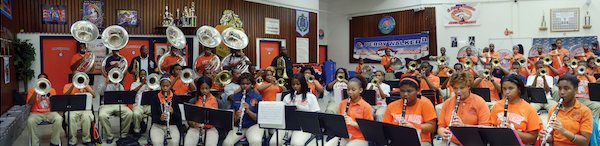
O. Perry Walker High School Marching Band. Photo by Aubrey Edwards.

O. Perry Walker High School Marching Band. Photo by Aubrey Edwards.

The walls of the band director’s office at O. Perry Walker High School are plastered with newspaper clippings. One, from The Times-Picayune of February 12, 2010, features a photograph of the Walker marching band with the Krewe of Alla. Another, considerably more yellowed, has them marching with the Krewe of Aladdin in 2002. And nearby, a framed certificate from Krewe D’Etat congratulates the band “for their outstanding performance in our 2008 Mardi Gras parade.” The dominant bit of décor is a large, hand-painted horse’s head, white with a windswept orange mane and a fierce expression: the symbol of the O. Perry Walker Chargers.

Band director Wilbert Rawlins, Jr. rises from his maroon leather-upholstered swivel chair and leans out the doorway at a pack of young trumpeters. “I already told you, son, I’m not the mouthpiece fairy! You find it yourself!” He returns to his chair with a sly smile. “Sometimes you gotta be aggressive with them.”

Preparation for parade season starts in earnest for the kids at Walker when they return from Christmas break. Now, in mid-January, the kids are drilling the 20 or so songs that will be their Carnival repertoire. Alongside Walker standards such as “Jump Start” and the Four Tops’ “Reach Out, I’ll Be There” will be a few new selections. “This is 2012,” notes Rawlins. “You’ve got to play something from their time. The song they nominated was ‘Moves Like Jagger’ by Maroon Five.” It’s a tune with the sort of simple, forceful melody that transitions gracefully into the brass band idiom.

When you watch a parade from the sidelines, the marching bands pass by like train cars. Each one is a snapshot and occupies your attention for no more than a minute or two. From the kids’ point of view, things are very different. It’s easy not to appreciate the sheer physicality of it all. “You have to march five or six miles,” Rawlins says. “You’re going to play 20 different songs, maybe 10 times a parade. That’s 200 songs, five miles, thousands and thousands of steps, in a uniform that’s probably hot as all outdoors.”

Peter Oatis is an 11th grader and a three-year veteran of the Walker band. Like most bass drummers, Oatis is a big kid. “They put me on bass drum because of my weight,” he says. “You have to get in shape to play it because it’s a mighty big drum.” Carrying that drum for miles at a time takes a physical toll. “In the morning,” he says, “you’re gonna feel it.” And while the bass drummers might have simple parts, they face a unique pressure. “When you play bass drum, you’re the heart of the song. If the bass drums slow down, the whole song slows down.”


Wilbert Rawlins, Jr. O. Perry Walker marching band Director. Photo by Aubrey Edwards.

Wilbert Rawlins, Jr. Photo by Aubrey Edwards.

As a child, Rawlins’ first instrument was the clarinet. “When I was a kid, they had these billboards up with Pete Fountain on them,” he remembers. “He had a clarinet in his hand with gold keys. “I was like, ‘I want to play that.’ I always did love gold,” he says with a smile, flashing his gold watch, gold cufflinks, and gold rings—one on each hand.

Today’s New Orleans is notably lacking in clarinetists with a popular presence of the type Fountain once enjoyed. The local musicians that kids look up to today are almost all brass players, and that’s reflected in kids’ attitudes toward the instruments. “It’s difficult to get some of the boys to play the clarinet,” Rawlins says. “That’s okay, there’s enough girls to go around. But I’m working on putting a couple of boys in there. Once you get that male-female competition in one section, now you’ve got something going on.”

That’s a phenomenon that Angelique Bass is more than familiar with. An 11th grader in her second year at Walker, Bass is the only girl in the band’s snare drum section. “I get a lot of props for it,” she says. “I have a lot of girls that come up to me asking ‘Are you really in the drum section?’ and saying, ‘I’m going to join too!’ I say, ‘Alright, come on. We’re looking for more girls!’” As of this writing, no one has taken her up on that offer.

Wilbert Rawlins, Jr. Band director of O. Perry Walker High School Marching Band. Photo by Aubrey Edwards.

Photo by Aubrey Edwards.

As a snare drummer, Bass says one of the biggest difficulties is maintaining the required posture—arms held to the sides, elbows bent, wrists constantly flexing—throughout an entire parade. “My arms get cramped up,” she says.

Brass and wind players face the problem of keeping their mouthpiece and instrument steady and upright throughout the parade. “You’ve got to come down on the tip of your toe first, then the ball, then down to your heel,” Rawlins says. “That’s the way you absorb the shock of your march, so that you can keep the mouthpiece in your mouth and you don’t get all this jerking and moving sensation.

“You need to have on two or three pairs of socks to have just a little more of a shock absorber—and to catch all the sweat,” he says. Sweat compounds another problem: chafing. Imagine that snug polyester in between your legs, rising and falling with every one of the 10,000 steps of that high-stepping gait in a five-mile route. Multiplied over eight or nine parades. Up and down. Back and forth. Rubbing and rubbing. “The inside of your legs, that’s probably the most tender skin you have on your body,” he adds. “You have to wear tights under your uniform, so the inside of your thighs won’t continue to rub against each other.”

That’s a bigger problem for some kids than for others. “I’ve had kids that weighed 300-plus pounds,” Rawlins says. “It’s very difficult for them to march the distance. With that friction going back and forth, you get boils between your legs, especially carrying that kind of weight. But you can’t exclude these children; you have to work with them. Even help them with their diet. If I have a kid that’s overweight and I know that nine parades is going to be pretty much impossible, I might allow him to march the first parade, and rest the second.”

O. Perry Walker is taking on a demanding schedule this year. Six of their nine parades will be back to back, Wednesday, Thursday, Friday, Saturday, Sunday, and Monday. In spite of all the physical stress inherent in the activity, one student dreads a decidedly different aspect of marching. “It’s tough not stepping in horsepoop because you can’t really see at night. Then your whole night’s messed up until you find some grass.”

Yet even with all the demands of marching—the physical strain, the maintenance of discipline, intra-group pressures—most every kid has the same attitude. “I have so much fun that I don’t feel the soreness coming until I get home,” says Bass.

“In the parade, I don’t feel none of the pains,” says Oatis. “I’m going to do it because I love it.”


It’s three o’clock on a Wednesday and the first kids are trickling into the band room from class. In one corner, a few of the percussionists have started an impromptu drum battle, trading high-speed rolls on top of a bass drum. Rawlins strides into class in his bowtie as warm-up is coming to a close, and leads the band in an arrangement of the 1992 Chanté Moore song “Who Do I Turn To?” As the band reaches the refrain, Rawlins intones the lyrics: “Still tellin’ me lies and makin’ me cry / I don’t need you.”

“Chanté wrote this about her man,” he informs the students. “He’s treating her bad and she’s mad as all outdoors! Let’s try it again.” As the band hits its stride, the energy in the room starts ramping up. The sousaphones sway from side to side with the beat as Rawlins, now risen from his chair, strides between the rows, arms up, rocking in time, calling out measures: “21! 22!”

History and math might seem distant thoughts as the kids pull out their music for “Moves Like Jagger,” but in truth, academics are a constant—if unspoken— presence in Rawlins’ classroom. Students at O. Perry Walker must maintain a 2.5 grade point average or be expelled from the band. “Anything less than a C and you can’t march,” says senior Brandon Diggs. A trumpeter and training drum major, Diggs is unequivocal about the motivating effect the policy has on kids. “If you’re looking at all your friends marching and you’re not marching because you messed up in class, you’re gonna go to your teacher and kiss up to get your grade higher and keep it there. Because that feeling ain’t nothing nice.”

Fortunately, most kids do make it back in. “The ones that don’t come back, they’re the ones that end up getting into bigger trouble and getting kicked out of school.” Diggs knows plenty of kids whose grades would be worse without the band as a motivator. “I’m one of them,” he says.

“I’ve got kids in here that are 4.5 scholars, all the way down to kids who came from other schools with a 0.2 GPA when they first got here,” Rawlins says. “Some of the kids come from the depths of the projects, some come from two-parent homes, some from single-parent homes. I have two or three kids in the band who are living in the shelter. Some are struggling with their identities. Music is the only common link.”

O. Perry Walker Marching Band uniforms. Photo by Aubrey Edwards.

Photo by Aubrey Edwards.

In his six years at Walker, Rawlins can only recall a handful of kids who have failed to recover their 2.5 and return to his band. But dismissing a kid from the band remains the hardest decision that he makes as band director. “You have the child’s entire life in your hands. You can’t teach a lesson through that child. Sometimes we do that as adults. We want to show the rest of the band so we say, ‘I’ll put him out’ when that’s still a child.”

Ultimately, Rawlins is a pragmatist about the role the band has in a lot of his students’ lives, recognizing that often its greatest merit is the simple fact that it keeps kids indoors and supervised throughout the afternoon. “Between the hours of 4 and 8 p.m. is when scientists say kids make the worst decisions of their lives,” he says. “Most of their parents aren’t home yet. They’re being led and taught by peers.

“When I was a young teacher at Sarah T. Reed, I had a student who played trombone. He was messing up in his classes. He didn’t come to school on time, his discipline and decorum was very disrespectful. So I put him out of the band. I knew he loved the band.”

The student shaped up quickly, coming to school every day, working harder in his classes, but no sooner was he back in the band then he started sliding back into his old ways. Rawlins was forced to kick him out again. “I remember him getting on one knee, saying, ‘Mr. Rawlins, I promise I’m never gonna mess up again. Please let me back in the band. Please let me back in the band.’ I said ‘No way, man. You messed on me once. You messed up my good reputation.’”

As Rawlins reflected on the incident, his heart began to soften. “I started thinking he might be ready to get back in the band. I talked to his teachers. But I said, ‘I’m going to let him suffer a little bit longer, so we won’t ever have to go through this again.’ Two days later, that trombone player got killed at five o’clock on a Wednesday evening. Where do you think he’d have been at five o’clock?

“I remember myself saying, ‘You messed with my reputation.’ That band wasn’t for me. That band was for him.”


O. Perry Walker Marching Band. Photo by Aubrey Edwards.

Photo by Aubrey Edwards.

Another of the clippings on Rawlins’ office wall shows him, smiling broadly, draping a Chargers jacket over the shoulders of Yoshio Toyama. Toyama, the “Satchmo of Japan,” has been an important benefactor of the O. Perry Walker band in recent years. In another clipping, Toyama is in the midst of a trumpet duet with a Walker band member. As you stroll through the school’s instrument closet, you’ll see case after case adorned with the logo of Toyama’s Wonderful World of Jazz Foundation. Others are donations from the Tipitina’s Foundation’s Instruments A-Comin’ program. It’s an impressive show of philanthropy. It’s also a jarring reminder of the current state of public funding for school music.

By the time you read this, the kids at O. Perry Walker will be well into their physical training regimen. “We’ll go outside to the football field and march around it one time,” says Rawlins. “The next day we’ll do it twice. Then three times. Then four times. Soon we’ll be marching around the field 20 times.”

Rawlins takes a more holistic approach to the band’s academic policy these days. “I had a young lady in the band by the name of Kelly,” he says. “Kelly was mentally challenged. Her parents didn’t take the right precautions to get her in the right situation. Somehow she got to the ninth grade reading at a fourth grade level, but she played the flute beautifully.” Kelly was going to tutoring every day but her grades remained low. “I remember Kelly coming and saying, ‘Please don’t put me out the band. This is the only thing I have.’” Mr. Rawlins did put Kelly out, but he changed his mind about 20 minutes later and became her personal tutor. “Kelly graduated last year. She’s now a member of a university marching band.”

If you talk to the kids in the Walker band, you’ll find that many have more than just high school on their minds as they gear up for this year’s parades. Many of the kids can count on band scholarships when they graduate. “I know it’s going to take me somewhere I want to be,” says Oatis. “To the next level, which is college. My first choice is Southern University.” Bass has her sights set on the College of Pharmacy at Xavier University, where she too hopes to continue her drumming.

But in the here and now, the allure of the marching band remains more or less what it has always been. A marching band, more than anything else, is a school’s ambassador to the community. That means pride and prestige of a kind kids can find few other places. “It’s more hyped [than the football team] because football is just at the beginning of the year,” says Bass. “The band is all year round.

“It’s like you’re a celebrity. Everybody wants to see you walk.”