Gretna Heritage Festival 2010

What Will Santa Say?

kermit.inside.final

Photo by Elsa Hahne

The adults are sitting around a table on the back porch, some with beer, some with coffee. They’re swapping wisecracks and stories while the kids are upstairs. Coats are tossed in a corner, and the Christmas lights are strung with semi-deliberation in one of the rooms of the house. It could be Christmas, but it isn’t. The house is Susan Cowsill and Russ Broussard’s home on the West Bank, and it has become the studio where A Very Threadhead Holiday is being recorded. Mike Mayeux’s mobile recording unit is out front; there’s an amp in the hallway with producer Paul Sanchez’ hat on it. The lights are hanging from Broussard’s drum kit.

The session shares more than cosmetic similarities with the holiday its celebrating, though. It’s hectic, as the schedules of Alex McMurray, Craig Klein, Shamarr Allen, John Boutté, Margie Perez, Debbie Davis, Matt Perrine, Mary Lasseigne, Broussard, Cowsill and a handful of others have to be accounted for despite a three-day deadline. Sanchez is trying desperately to stay within some semblance of a budget as everybody hears one more part, one more instrument for their songs, one more little expenditure that adds up when multiplied by 10. The heightened emotions caused by the occasion lead to tempers flaring, a little sulking, and a lot of antic humor. Beneath the wisecracks, though, there’s also a fundamental bonhomie—a genuine affection that underlies friendships and families.

The album caps a busy year for Threadhead Records, which helped all the artists involved release albums this year except Cowsill, who’ll release an album on Threadhead in March. A Very Threadhead Holiday presents their takes on the holiday, and all wrote new songs for the occasion except for Davis—who covered the Squirrel Nut Zippers’ “Hanging Up My Stockings”—and Perrine, who tuba-cizes “Carol of the Bells.” The album is also part of a busy year for Christmas music in New Orleans. Kermit Ruffins cut Have a Crazy Cool Christmas (and will debut it live at his birthday show at the House of Blues December 19), Charlie Miller recorded the solo trumpet Christmas in New Orleans (which he’ll perform at Snug Harbor December 6), and John Mahoney recorded a big band Christmas album, Christmas Joy (which he’ll premiere December 1 at 7:30 p.m. in a free show at Loyola’s Roussel Hall).

Because Christmas music occupies a strange place in people’s consciousness, so much activity seems improbable. These songs, after all, have been so thoroughly recorded and are so well known that any new Christmas album seems a little redundant. They’ve been such a part of our lives since childhood that it can be hard to take them as seriously as more “adult” music, and Mahoney admits, “The idea started as a joke.” Judith Owen and Harry Shearer have fun with Christmas music at their Holiday Sing-a-Long (December 18 and 19 at the Contemporary Arts Center), but as Shearer observes, the songs are more than that. “In New Orleans, we have a canon of music that surrounds us all the time that people are always listening to and reinterpreting,” he says. “For the rest of America, Christmas is as close as it comes to that. It serves as that kind of canon that you can keep revisiting and keep experiencing and reinterpreting it, but there’s no escaping it.”

Christmas music is fraught with ironies, not the least of which is the circumstance of its recording. The mechanics of getting the recordings through the record-making machinery and to market in time for the season often means recording Christmas songs in the heat of summer. The Simpsons once showed Krusty the Clown dashing off the golf course and into the studio to half-ass his way through a Krusty Christmas album, and it’s easy to imagine that Dean Martin and Frank Sinatra’s Christmas albums were cut under similar circumstances. John Mahoney cut Christmas Joy in June, but unlike Cowsill and her lonely string of lights, Mahoney made no effort to Christmas-up the session. “It was all nuts and bolts,” he says, “because we had a lot of hard music to rehearse and record in a limited amount of time. However, at the mixing sessions, my sonin- law, who was the recording engineer, brought a small artificial Christmas tree to the control room to keep us in the spirit.”

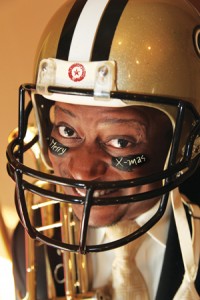
Kermit Ruffins didn’t string up lights or bring in a tree. Instead, when he cut his album at the Music Shed, he did what he always does. “I brought my big-ass barbecue pit and we opened up the back shed,” Ruffins says. “We ate more hot sausage, told more jokes and played some beautiful music. All you can eat, all you can drink.” Everybody involved ate like it was Christmas day, but that was for fun; it wasn’t necessary. “We definitely fell right into the vibe. Christmas is my favorite time of the year.”

That lack of seasonal inspiration would seem to be an impediment to a quality recording, but almost everyone involved in Christmas recordings this year found compelling musical reasons to do Christmas songs. “I approached all seven tunes as viable jazz vehicles, suitable for my arranging and the players’ improvisational skills, and as a result the musician often forgets that it is a Christmas tune he or she is playing,” Mahoney says, and in a city where some of its best musicians cut “They All Asked for You,” it’s no surprise that Ruffins’ band—Herlin Riley, Matt Lemmler and Neil Caine—could stay on task and swing hard, even on a swift, almost breathless version of Louis Prima’s “What Will Santa Claus Say (When He Finds Everybody Swinging?).”

cowsill

Photo by Elsa Hahne

For Susan Cowsill, Christmas songs speak to her on a musical level. The Carpenters’ “Merry Christmas Darling” is one of her favorites because “it’s got beautiful harmonies,” she says. “And I think I was having a good year.” One of her earliest Christmas music memories is of listening to the melody and countermelody of “Do You Hear What I Hear” as a child in Rhode Island. “It blew my mind when I was little,” she says. “I liked all the different things that could fit into this one simple melody,” she says. “I can remember laying in front of our hifi that was warm—it even smelled like it was burning—and thinking of all those parts.” For her “The World at Christmas Time,” figuring out the harmonies was the easy part. She and Debbie Davis took turns thinking of harmony parts to add; the musical challenge was for her as a pop songwriter to put the song in Christmas musical vocabulary. “The mystery of Christmas is often expressed through not-your-average chords; I think you’ve got to have some sharps and minors in there.” Alex McMurray discovered the same thing when he played “Sleigh Ride” with the Drunken Masters—Jonathan Freilich, Phil DeGruy and himself. “The song’s pretty complicated and has some really strange changes,” he says.

Charlie Miller’s Christmas in New Orleans is very much a music-driven experience. It’s a series of tracks that present his horn alone in a wintry, meditative mode as he examines the classic melodies for the improvisational opportunities they offer. On “The Christmas Song,” he experimented with dissonance. “I fooled around with the scale, with the pitches, and I was purposely hitting notes that weren’t the true notes, that some people might consider out of tune,” Miller says. “I don’t know what those pitches are, but I hit some notes that aren’t the true notes, and it worked as far as I’m concerned. Like a gospel singer would sing something flat and move it to the true note. The end of the note goes to the exact pitch. It’s a way of resolving.”

“These are the songs that everyone’s mandated to hear once a year whether you like them or not,” Debbie Davis says. She and husband Matt Perrine are not only a part of the Threadhead Christmas album and regular participants in Owen and Shearer’s Christmas Sing-a-Long, but they’ve recorded Christmas songs as gifts for friends for the last few years. The challenge in recording Christmas music, she says, is dealing with everybody’s lengthy history with the music. Everybody starts singing these songs in school Christmas pageants if not before. Miller remembers singing Christmas songs around the house with his parents, and Sanchez caroled in the Irish Channel with his family. For Kermit Ruffins, many of the songs on Have a Crazy Cool Christmas date back to high school. “Everything revolved around high school with Rebirth,” he says.” We’d take the tunes that we’d play in high school and give them a second line beat.” The album includes a version of Donny Hathaway’s “This Christmas” that he used to do with Rebirth Brass Band, and they join him on the album. “We wore it out at the Glass House back in the day. Only in New Orleans can we take a tune like that and second line to it.”

Alex McMurray remembers listening to the radio with his family growing up in the early 1970s. “We had a cheap Sears stereo, and we listened to this easy listening station, WHTG out of Patterson, New Jersey it came out of, and they played Andy Williams and Johnny Mathis and that sort of lush, easy listening stuff,” he says. “But we were kids, so it was all about the cartoons.” The songs from the animated Christmas specials made an impression on him, particularly “Christmastime is Here” from Merry Christmas, Charlie Brown. “It was almost too weird. It was really affecting, even though it was only on for a few seconds. It’s got funny chords and it’s very advanced harmonically. I’m a Vince Guaraldi man.” McMurray’s a New York Yankees fan, and that fandom affected his appreciation of Christmas songs when he was in third grade. “We had a Christmas pageant at the school and we sang ‘O Holy Night.’ I imagined that it was about Reggie Jackson, that he was the chosen one. The ’77 World Series had just taken place and the three dingers—four, really. ‘Fall on your knees and worship Reggie Jackson.’”

Because the songs evoke such vivid, distinctive memories, recording them forces musicians to think carefully about what how to handle them. “Everybody knows these songs, but you have to make people feel like they’re hearing something for the first time,” Debbie Davis says. “That’s what everybody wants for Christmas; they want the familiar comfort, but they want to feel like they’re hearing something new.” McMurray cut “The Christmas Song” with the Royal Fingerbowl, and transformed it by adapting it to the band’s lineup, and John Mahoney similarly lets the lineup do much of the work. “Five saxes, four trumpets, four trombones, piano, guitar, bass and drums make a huge palette of sounds,” he says. As an arranger, he further transformed the songs. “‘O Little Town of Bethlehem’ is a jazz waltz,” he says. “‘Silent Night’ is in a gospel-like six, ‘Lo, How a Rose E’er Blooming’ is a 5/4 bolero, and ‘O Come, O Come Emmanuel’ is a modal even- 8th feel with added Latin percussion.”

Some adaptations get to the heart of the matter better than the ur-versions. Taylor Swift’s “This Christmas,” for example, surpasses Wham!’s because the sentiments sound truer when sung a teenage girl than a man in his 20s. Davis’ treatment of the Squirrel Nut Zippers’ “Hanging Up My Stockings” on the Threadhead album surpasses the original because, when shorn of the band’s neo-swing element, the song emerges as one that could become a standard. When Ruffins remakes the standards, he joins a proud tradition of jazz Christmas recordings. He picks up the tempo of “Silent Night” without losing the song’s beauty, and he cheers up “O Christmas Tree,” aided by Lemmler’s barrelhouse piano.

The intersection of tradition and invention that Christmas songs mark make them songs that many musicians enjoy returning to, at least for the season. Cowsill recalls a Christmas concert at St. Louis Cathedral that she did with Jim McCormick and Skeet Hanks. “I was in heaven as a vocalist,” she says. “There’s nothing like it.” Davis and Perrine have found kindred spirits that play on their Christmas sessions. “We throw them a little money when we can, but it’s basically done for the freakish joy of playing these songs that it’s only sanctioned to play once a year,” Davis says.

“Christmastime is Here” may be the most recent song to enter the holiday canon, and it was recorded in 1965. “This Christmas” is the next contender (1984), along with John Lennon’s “War is Over (Happy Xmas)” (1971). For the most part, the enduring holiday songs were written before the Beatles and Rolling Stones changed the nature of rock ’n’ roll. Now, new Christmas songs are too rooted in their milieu to achieve the timeless quality of the best-loved songs. One of the most popular modern Christmas songs is the Pogues’ “Fairy Tale of New York” (1987), but it starts in the drunk tank, and the romance that emerges ends with the fight:

You´re a bum, you´re a punk.

You´re an old slut on junk

lying there almost dead on a drip in that bed.

You scumbag, you maggot.

You cheap lousy faggot.

Happy Christmas your arse. I pray god it´s our last.

Good times. For A Very Threadhead Holiday, Paul Sanchez wrote or co-wrote five of the album’s 12 tracks including his own “Drunk for Christmas.”

“I wrote that when I was a single, drunk bachelor,” he says, but he also co-wrote “Holding You for Christmas” with John Boutté, and he made a conscious effort to write something more conventional. “He tends to like what most people like—the universal truths,” Sanchez says. “Originally the tag line was ‘This Christmas New Orleans almost feels like home.’ He said, ‘I don’t want to say anything about New Orleans. Everybody knows I’m New Orleans. And “almost feels like home” is too sad. I’m tired of being sad. I want to sing, “Holding you this Christmas feels like home.” The result is a song you could imagine others covering in years to come.

For the album, Alex McMurray went to his comfortable place with “Santa Let Me Call You a Cab.” “Novelty songs I’m good at,” he says. The title is one he had toyed with for years, along with the image of a Christmas night being ruined by a drunken Santa modeled on Dan Ackroyd’s character in Trading Places that scares the kids and runs off with the narrator’s wife. “When the Threadheads said that they wanted to do a Christmas record, I thought I should at least try to write this song. I finally got that off my chest.”

For Cowsill, who admits she has likely worked snow and Christmas into more non-seasonal songs than most, the fear of screwing up a Christmas song was daunting. “That would have been the height of failure for me,” she says. Cowsill’s not typically a fast writer, but she got the first verses and chorus of “The World at Christmas Time” out easily, and she knew how it ended. It was the parts in-between that challenged her. “The main thought was, ‘I feel this way all year long; at Christmas time the world feels the same way.’ How to get there and how to discuss the unpleasantries of life, that was tough.”

While Kermit Ruffins’ album is dominated by well-known songs, he wrote one original, “A Saints Christmas.” In it, he sings, “All I want for Christmas / is the Saints in the Super Bowl.” He cut the song before the first pre-season game was played, and he makes no secret of his love for the Saints. Ruffins tailgates at different bars around town for each game, cooking out front and DJing during the commercial breaks (playing “Who Dat” and his own song, naturally). He has Drew Brees and Reggie Bush jerseys, countless T-shirts, a Saints ornament for his Christmas tree, and he gets animated talking about Jeremy Shockey’s contributions this year. It’s hardly traditional Christmas music fare, but “A Saints Christmas” speaks to New Orleans, and the prospect of it coming true is so hard to imagine that Ruffins gets quiet when he talks about it. “I think we stand a good chance,” he says, hushed. “I keep thinking, get a hotel room (in Miami, the site of the Super Bowl) now. At least be there with the barbecue grill staked out somewhere with a TV hanging out of my truck. You’ve got to be there. It’ll be a mini-Jazz Fest Friday and Saturday with another tailgate Sunday.”

Ruffins’ vision is one that unifies New Orleanians, and it’s the thing good Christmas music does. “As you get older, which I am really fast, people become more important than everything,” Charlie Miller says. “Christmas time is a time when people are coming together in a joyous way, so from that aspect, [the songs] are very much fun to play because people like them.” Cowsill echoes that thought. “It brings people to a place where our core exists anyway—joy and goodness,” she says.

The best songs, Debbie Davis says, are “not afraid to be what you’re supposed to be at Christmas, and what few people truly ever are, which is happy, thankful, sincere and emotionally exposed. I think that’s part of what makes Christmas hard for some people, and when someone’s brave enough to do it, it’s its own reward.” Christmas songs may be sappy, sentimental or corny, but she rejects those thoughts as rock ’n’ roll-speak. “Nothing can be corny if at some level, everybody hasn’t had it appeal to them in an honest and complete way. People say The Wizard of Oz is corny; it’s because you’ve seen it 11 times. You may pretend you don’t like it, but it’s part of you, and it can’t be part of you unless you loved it. Sid Vicious wanted something under the tree just like everybody else.”

See extra photos taken at the shoot for this story

  1. [...] [1] What Will Santa Say? :: offBeat :: Louisiana and New Orleans … [2] 99 Places – A Travel Community for San Francisco Bay Area Families [3] SoCal Postal Workers [...]

Leave your own Comments

blog comments powered by Disqus
Legendary Rhythm and Blues Cruise