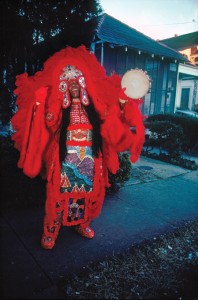
The Wild Tchoupitoulas' Big Chief Jolly by Syndey Byrd
Let’s face it, music is as much a part of Mardi Gras as Zulu, Rex and hangovers. Not surprisingly, the majority of classic Mardi Gras songs were recorded during the golden era of New Orleans rhythm and blues, roughly the late 1940s to mid-1960s. The brass band revival of the 1980s provided a few Carnival musical highlights, but it’s been a long time since someone has written or recorded a Mardi Gras song that has really captured the public’s attention. Why? “I don’t know, but there sure hasn’t been one in a while,” says James “Sugarboy” Crawford, laughing.
Crawford accounted for the Carnival classic “Jock-A-Mo.” “Maybe it’s because Mardi Gras is too civilized now. When I wrote ‘Jock-A-Mo’ over 50 years ago, the (Mardi Gras) Indians carried knives and hatchets. When one tribe got in another tribe’s territory, they started fighting. Now it’s pretty much a fashion show for them.
“Plus, Mardi Gras isn’t just a New Orleans event anymore. It’s seen and celebrated all over the world. When Professor Longhair sang, ‘You will see the Zulu King on St. Claude and Dumaine,’ that was a big thing then. Zulu only had one float then and they didn’t have a set route; they just went barroom to barroom. Now everyone can watch the parades on TV.”
Warren Hildebrand heads up Mardi Gras Records and released Mardi Gras in New Orleans, the first full album of Mardi Gras songs, in 1977. He agrees that there hasn’t been an identifiable Mardi Gras song to come along in some time.
“That hasn’t stopped people from writing and recording them, though,” he says. “There’re new ones almost every year. In fact, a guy pitched one to me just today and I told him I’d give it a listen and see if it’s good enough to put out next year. The last really identifiable Mardi Gras song I remember was Rebirth’s “Do Whatcha Wanna,” and that came out 20 years ago.
“Maybe it’s because there’s no singles jukeboxes any more. A lot of the classic Mardi Gras songs got to be popular from being played on jukeboxes. My dad had All South Distributors and we sold the Mardi Gras singles (to jukebox operators). When I started the label, albums were becoming real popular and I though it would be a good idea to collect the more popular Mardi Gras singles on an album.”
Some of these songs were on Hildebrand’s album; others should be.
Professor Longhair: “Go to the Mardi Gras”
A major source of Mardi Gras music was the late Henry Roland Byrd a.k.a. Professor Longhair. Longhair recorded “Go to the Mardi Gras” on several occasions, and as early as 1949. However, the definitive version was recorded in 1959 for Ron Records. Driven by his unique rumba piano, crashing horns and a crisp second-line drum beat, the song became Longhair’s signature. Longhair delivers what may well be the ultimate musical New Orleans travelogue. It’s probably the best known of all Carnival songs and has been covered several times, most notably by Fats Domino in 1953 under the title “Mardi Gras in New Orleans.”
Professor Longhair: “Big Chief”
Penned by Earl King, and recorded by Professor Longhair in 1964, the inspiration for “Big Chief” wasn’t the Mardi Gras Indians, but rather King’s mother.
“I wrote ‘Big Chief’ back in school,” recalled Earl King in 1982. “When we went to work on this project with Professor Longhair, I got to thinking about the Mardi Gras, and went back to my book.
“Me and Wardell (Quezergue) wrote out the horn arrangement for 15 pieces. Meantime, me, Fess and Smokey Johnson got together and rehearsed it. When we got to the studio, Fess thought there was going to be four-pieces, but there were all these musicians hanging around the studio. Fess says to me, ‘What are all these guys doing here? I guess they’re waiting for the next session, huh?’
“I said, ‘Probably so.’ So Fess gets in behind the piano and plays his little intro, then Smokey and the rhythm section falls in, then all of a sudden, where the big crash of horns come in, Fess stops playing— bam! He says, ‘What is that?!’
“I said, ‘That’s the rest of the guys that are playing on the session.’ So we took a 15 minute break for Fess to compose himself. He says, ‘Man, we really don’t need all them.’
“I said ‘I know, but they’re going to play, man.’ After he got his head together, he was all right.”
Al Johnson: “Carnival Time”
When Al Johnson composed “Carnival Time,” he was just looking to come up with something, “A little different.”
“The lyrics say let them (the clubs) burn down, but the places weren’t really on fire—I just meant that people there were having a good time.
“We tried to get the song out earlier, but the musicians couldn’t get it together. I was told that to be good, you had to be different. Well, ‘Carnival Time’ was so different the musicians had a hard time playing it (Apparently, there were multiple takes on the song and several musician changes before they came up with an acceptable master.) I still don’t think they got it 100 percent right.”
Released right before Mardi Gras in 1960, the single didn’t do much at the time, but in later years, its popularity increased. Now Carnival wouldn’t be complete without it.
The Hawketts: “Mardi Gras Mambo”
The Hawketts were a group of teenaged musicians led by vocalist/ keyboardist Art Neville. Their version of “Mardi Gras Mambo” was a cover of a string band recording, originally recorded by Jody Levins. The Hawketts’ version was produced by New Orleans disc jockey Ken Elliot a.k.a. Jack the Cat at radio station WWEZ. He in turn leased it to the Chess label in Chicago. It was an instant hit on the streets of New Orleans. Two decades later, it was covered again by the Meters, a group led by Art Neville.
Sugar Boy Crawford: “Jock-A-Mo”
“I’m not singing ‘Jock-A-Mo’ on that record,” specified Sugarboy. “I’m singing ‘Chock- A-Mo,’ The label (Checker) misspelled it. But after it came out, there was nothing I could do.
“‘Jock-A-Mo’ came from two songs that I used to hear the Mardi Gras Indians sing. When I was growing up, I lived near the Battlefield (Simon Bolivar and Melpomene Street) where the Indians paraded. When they ran up on each other they’d shout, ‘Jock-AMo- Fi-Na-Na’ and ‘Iko Iko.’ When I recorded ‘Jock-A-Mo,’ I didn’t have in mind to do a Carnival record; I just wanted to do a good song.”
“Jock-A-Mo” proved to be a local best seller prior to 1954’s Mardi Gras, but was forgotten by Ash Wednesday. However, for two weeks every year since then it renews its popularity.
Bill Sinigal & the Skyliners: “Second Line”
While “Second Line” has become a marching and brass band favorite, the song has rhythm and blues roots. Bill Sinigal was a popular R&B saxophonist/bass player. His trumpet player, Milton Batiste, played R&B and Dixieland music.
“Second Line” is actually a combination of two songs,” recalled Batiste in 1989. “‘Picou’s Blues’ and ‘Whuppin’ Blues.’ The idea for the intro came from Dave Bartholomew. He’d play that riff when he wanted to get the band back on the bandstand.”
Recorded on Cosimo Matassa’s White Cliffs label in 1963, the single did well locally during Carnival until White Cliffs folded in the late 1960s. The master disappeared and no more singles were pressed. Record stores still got requests for the song and it was covered by a group from Baton Rouge, Stop Inc., on JB’s Records in 1974. Sinigal’s version has since been reissued by Universal, but the Stop Inc. version has supplanted the original in popularity.
The Wild Tchoupitoulas: “Meet De Boys on the Battlefront”
“Meet the Boys on the Battlefront” was a virtual plan for a Mardi Gras Indian tribe on Mardi Gras day. The Wild Tchoupitoulas was a 13th Ward tribe led by the spirited George Landry a.k.a. Big Chief Jolly. Besides his tribal duties, he played a mean blues piano and was an inspiration to his nephews, the Neville Brothers. In 1976, Art Neville thought recording his uncle singing traditional Mardi Gras Indian songs with his band the Meters, and his brothers, might be a good idea. Turned out it was, as The Wild Tchoupitoulas album is a classic. The album contained “Meet De Boys on the Battlefront,” where Landry bragged about how pretty and tough his tribe was.
Smokey Johnson: “It Ain’t My Fault”
This was an R&B instrumental recorded for NOLA Records in 1965 that has since become a brass band favorite.
“Smokey came by the office one day and said, ‘I got a song I want to record,’” said arranger Wardell Quezergue, referring to the innovative drummer. “I said, ‘How does it go?’ Smokey started tapping the drum part on my desk with his knuckles. I said, ‘That’s great, but how does the melody go?’ Smokey says, ‘Quiz, I ain’t got one. You got to come up with that.’ Well, I wound up writing a melody that complimented the beat. The title was just something we pulled out of the air.”
Johnson’s single enjoyed brief local popularity but exploded when the young brass bands evolved two decades later. Now it’s played by nearly every brass band and high school marching band in New Orleans.
“I thought it was a great tune for brass bands,” added Quezergue. “It’s got a great second line beat and people love to hear it at a parade.”
The Meters: “They All Asked for You”
The city’s premier funk band, the Meters, recorded this on their 1975 Fire on the Bayou LP. “They All Asked for You” came from a century-old nursery rhyme often heard on the streets of New Orleans. It was originally recorded in 1952 by Paul Gayten as “They Asked for You (Down at the Zoo).” The Meters borrowed it, created some new lyrics, added a syncopated second-line rhythm and created a Mardi Gras classic.
The Wild Magnolias: “Handa Wanda”/”New Suit”
In a city of wonders, perhaps nothing is more wondrous than the Mardi Gras Indians tradition. In addition to marching through the streets in stunningly elaborate homemade suits, some of the tribes have recorded some very popular Mardi Gras music. One such tribe was the Wild Magnolias. While these two songs have been long associated with each other and were released on same album in 1976, they have completely different origins.
“Handa Wanda” was produced by Quint Davis and recorded in 1970 at the Deep South Studio in Baton Rouge. It was Davis’ idea to back up the traditional Indian chants with contemporary New Orleans musicians, and he put together a stellar band that included Snooks Eaglin and Willie Tee. The single appeared on Davis’s Crescent City label and became a Carnival best seller. The entire tribe is listed as writers of the song, including their Big Chief and lead singer, Bo Dollis.
“Handa Wanda” drew the Wild Magnolias to the attention of a French record producer, Philippe Rault, who had relocated to New Orleans. Rault signed the tribe in 1975 to Barclay Records, enlisting most of the same musicians from the earlier session. He brought them all to Studio in the Country in Bogalusa, where the Wild Magnolias recorded the Willie Tee-penned “New Suit.” The song became a popular single on jukeboxes across Central City.