Earth, Wind & Fire’s Verdine White

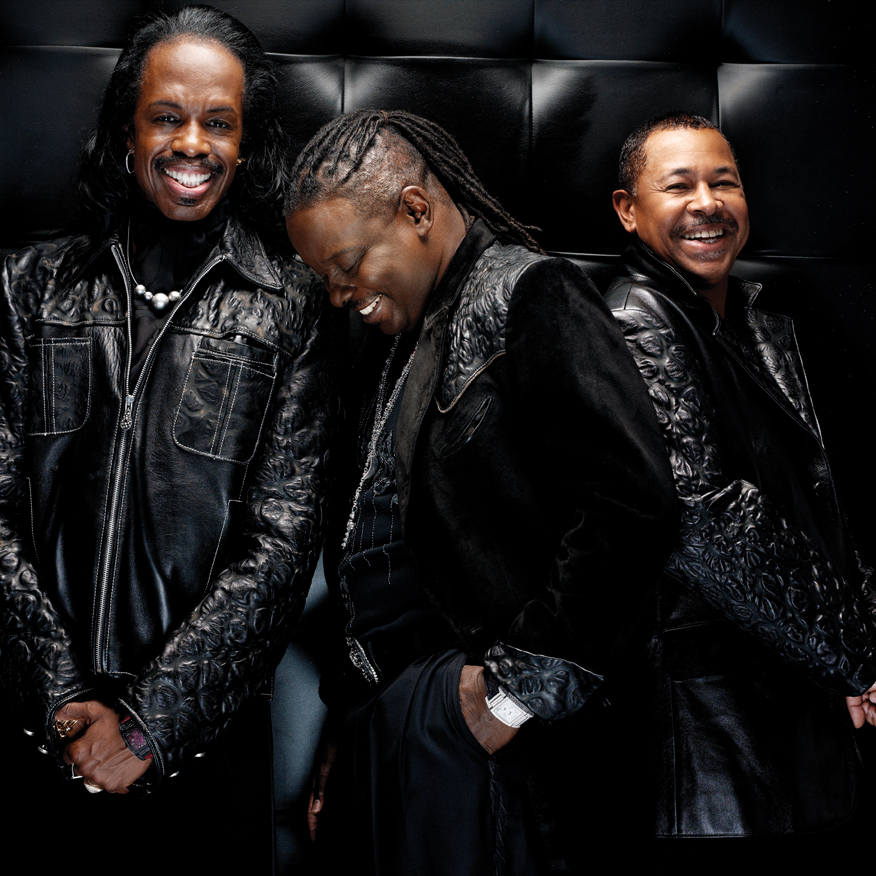
Verdine White, Philip Bailey and Ralph Johnson of Earth, Wind & Fire.

When Earth, Wind & Fire substituted for Aretha Franklin at Jazz Fest this year, the audience likely traded up, whether it realized it or not. Aretha today is not Aretha in her prime, and though EWF isn’t either, it’s a lot closer. Founder Maurice White no longer performs with the band because he suffers from Parkinson’s disease, and they no longer perform magic tricks onstage taught them by the late Doug Henning and his assistant, David Copperfield. They don’t defy gravity anymore, but vocalist Philip Bailey, drummer Ralph Johnson and bassist Verdine White (Maurice’s younger brother) don’t show many negative signs of having played in the band since 1972. Bailey’s falsetto is still powerful, and White is still in constant motion. Check the “Boogie Wonderland” video from 1979; the wardrobe and hairstyle have changed but not the enthusiasm.

EWF made its recorded debut on the soundtrack to Sweet Sweetback’s Baadasssss Song, Melvin Van Peebles’ ground-breaking movie from 1971, the first independent African-American film. The soundtrack, like the movie, was closer to the Afrocentric avant-garde of the day than the pop/jazz/R&B synthesis that would come to define the band. In our interview, Verdine White says they were never that radical again. The lineup almost entirely changed afterwards, with only the White brothers continuing in the incarnation that became a hit machine in the mid-1970s. But just as Maurice White’s gift for immediate, endearing songs obscured the uncompromised jazz and funk in their DNA, it’s easy to overlook the band’s album covers, which evoke the same sort of Afro-futurist spirituality that Sun Ra explored.

Earth, Wind & Fire return to New Orleans to play the Essence Music Festival, which takes place July 2-4 at the Louisiana Superdome. They’ll have a tall task ahead of them, following Mary J. Blige and occupying the closing slot previously held by Frankie Beverly and Maze. They may not inspire the mass electric slide that Maze did, but if the set doesn’t become a dance party anyway, it won’t be because Earth, Wind & Fire didn’t deliver.


How did Earth, Wind & Fire come to play Jazz Fest this year?

It was actually a last minute concert. Aretha Franklin cancelled. She got ill, and promoters called our management and we had to make a beeline out to New Orleans because she cancelled with about 10 hours to go before her appearance.

So it was just luck that you were going to be in the area?

That’s right. We were due to be in Biloxi Saturday night.

I was in my car leaving the gym (in Los Angeles) because I figured we had a day before we had to leave and then we had like, five hours to leave. It was a lot of logistics to move at the last minute. We had to leave early on Friday morning, about 3 o’clock in the morning from Los Angeles to get there in time to make the concert. We had to move about 40 people in about five hours. It was one of our greatest concerts ever that we played.

Were you involved at all in the negotiations between Essence Music Festival and Jazz Fest to make this happen? Your show at Essence was close enough that they had to have some say as to whether or not you could play the show.

Essence was very cool about it. We explained the situation and everybody understood. It actually probably helped the marketplace, too. It showed us, and people might say, “Hey, let’s go see them at Essence; they were pretty good.”

I read that you learned to play bass from Louis Satterfield (a bass player and trombone player associated with Chess Records who later joined EWF’s Phenix Horns)?

Yeah, the late Louis Satterfield. He passed away a few years ago. He was my wonderful teacher; he really helped me out a lot.

What can you tell me about being around Chess Records at that time?

Well Maurice was around it more than I was. I wasn’t around Chess too much, but I was around Sat and all those guys as a teenager, so I was just soaking it all in. I learned a lot of things that I probably wouldn’t have learned anywhere else or in music school. I did learn a lot in music school, but what I really learned was on-the-job training and being in the clubs and things like that.

How did Earth, Wind & Fire come to do the soundtrack for Sweet Sweetback’s Baadasssss Song?

Well, Maurice knew Melvin [Van Peebles, who wrote, directed and starred in the movie]. We did the full soundtrack in a day. It was the first of what they called at the time the black exploitation soundtracks. After that came Shaft, which was huge. Around that same time Superfly came out. It was the beginning of an era to hear African-American music in films.

What can you tell me about Melvin?

We were there when he was in the editing room at Paramount Pictures, and he gave an idea of what a song was going to be. He was great; he was a very driven person, great imagination.

What did you think of the movie?

Well it was real different, real radical. It was a very radical time in America. We hadn’t signed with Clive Davis at the time. We were a very new group, so for us to do a soundtrack at the beginning of our careers was amazing. We were happy just to have stuff in the movie, to have our music on the big, wide screen. At the time, there weren’t a lot of movies that had black music in it.

What were your musical influences?

Of course, Miles Davis’ Bitches Brew, Keith Jarrett’s Revolution, the Beatles’ Abbey Road. We were listening to John Coltrane. It was a very radical time.

I was like 19 years old or something like that. All of a sudden I was thrown into the whole thing that Maurice put together, all this high energy, this radical change in my life and soundtracks. Then we started to make records. Every couple of months, things were happening. It’s what a kid at 19 dreams of.

Was “That’s the Way of the World” the turning point for the band?

I think so. It was an unusual record for us, as well as radio and things like that. We tapped into something that was a totally different thing. It was a different sound and a different concept.

“That’s the Way of the World” started as a soundtrack, too?

That’s right; it was on the That’s the Way of the World movie. It was the same person who had done Superfly. Sig Shore had produced that movie and wanted us to be in that movie. He had heard about us, and he knew about the Sweet Sweetback soundtrack back in the day, a few years before.

Were you surprised when “That’s The Way of the World” became big?

I wasn’t surprised that people love the record because we loved the record. But I was surprised at the way it made people feel. The sales went through the roof. It was the first album by an African-American group that had gone number one on three different charts and the single, all at the same time. I don’t think it had been done since the Beatles or something like that.

Was there a point when you were conscious of how many people were listening to you?

Later. You don’t know it when you’re doing it; you don’t notice until later. It’s a good thing you don’t notice because then you’ll get unfocused.

Is there a quintessential Earth, Wind & Fire song? A song that does everything the band does well?

If you asked the pop audience, they’d say “September.” If you asked an African-American audience, they’d say “Devotion” and “Spirit.” If you asked a disco audience, they’d say “Boogie Wonderland.” It’s different songs for different people.

What about for you?

Probably “That’s the Way of the World” because it captured what we really are. Everything branches out from there.

How did the band come to do the elaborate stage show in the 1970s with the magic tricks, the pyramids, the space ship and the like?

Well it was one thing after another, after another. We wanted to have a show that everyone would go to. We had to give them something for their money.

Was that around the same time that P-Funk had the spaceship?

Yeah, they got their spaceship from our ship, you know what I mean? But everybody was doing great shows—Kiss, us, them. Of course, Michael Jackson came later with his elaborate shows. It was the golden age of live performances  where everything converged. It was really great for the audiences.
What was it like after five or six years of having hit single after hit single to have a point when hit singles stopped coming?

Well you always know they’re going to subside, but then in our case even though they subsided, it made us legendary. People got deeper with us because we weren’t as commercial as we once were. They went back to us, started checking out not only the commercial songs but the really hip songs. In a way, it made us hipper. After a while, a lot of people thought we stopped doing that on purpose. For any other group, it might’ve stopped their career completely, but for us it made us what we kind of are now.

How is Maurice’s health?

He’s good. He’s dealing with his challenges, but he’s doing really well. We are all going to be together June 17. We are being inducted into the Songwriter’s Hall of Fame in New York—David Foster, Leonard Cohen, us, and Phil Collins. It’s going to be a great night.

When you’re on stage, it really looks like nobody is having more fun than you are.

Well, it is the safest place for me to be at in that time, and it’s what I always wanted to do. When you get an opportunity to do what you want to do, you enjoy it. I mean, many people have dreamed about their life’s work, but very few get to obtain that.

Was there ever a point when it was a decision: “I am going to radiate enthusiasm when I’m onstage”?

I was like that as a teenager. I was in a local band, and I told the guy I was going to California, and he said, “Oh, you’re going out to California to be a star?” And I said, “No, I’m bringing my star with me.” I was ready for it.

blog comments powered by Disqus