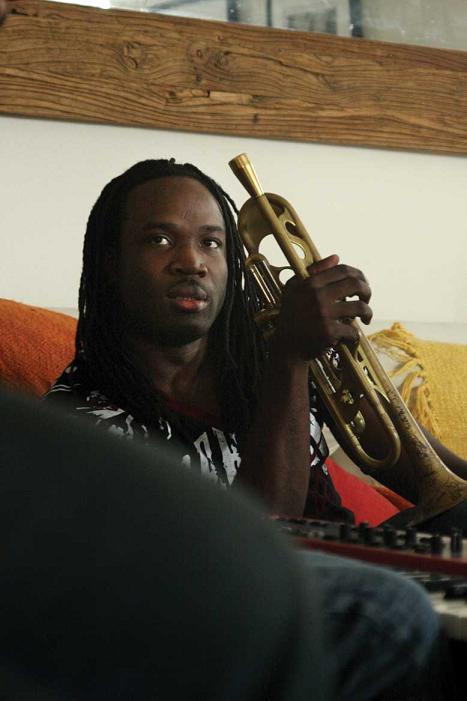
1907 Jourdan Avenue is situated just past the east wall of the Industrial Canal. Shamarr Allen recalls growing up there, practicing his trumpet at home with encouragement from his father and Kermit Ruffins. Playing with his childhood friend Dinerral Shavers, buddies so close people thought they were brothers.
But like so many other such New Orleans memories, Allen’s childhood recollections are clouded by the void that’s left behind. His house was so close to the levee break that destroyed the Lower Ninth Ward that there’s not a toothpick’s worth of it left standing. Allen lives in the Upper Ninth Ward these days. His father lives on the West Bank. Shavers was shot and killed in 2006.
“It’s so many memories,” Allen recalls of the Lower Nine, “like all the kids outside playing in the street and I’m sitting on my porch, practicing my trumpet. It was more like a family neighborhood. Everybody was so close and everybody slept at everybody’s house. It was just like one big family.”
Shamarr decided to play the trumpet at age seven after his father played him a Louis Armstrong record.
“My father, Keith Allen, played saxophone, but he wasn’t a professional sax player,” Shamarr says. “He did it for the fun of it. I played around on the saxophone, but I never took it seriously. I just fiddled around with it because my dad played it and every little kid wants to be like his dad. I was home and he was playing me some records, Herb Alpert and some other guys, and he said ‘listen to this.’ He played an Armstrong record and I was shocked. I was like, ‘Dad, whatever he’s playing, I want to play that.’ It seemed like he was having so much fun with his singing and his playing, the way the band played. It was so much fun that it made you want to have fun, too.”
Allen’s younger sister Kamaria played clarinet, and the two siblings would play at being Armstrong and Sidney Bechet at home. “We played together a lot,” Allen says. “We went to a lot of the jazz camps and stuff. But she grew up and left music alone.”
Allen’s real musical education began on the streets of the Lower Nine, where he and Shavers practiced leading their own second line parades.
“A lot of people thought Dinerral was actually my brother,” Allen laughs. “We told everybody we were brothers. My dad would always pick the both of us up in the morning and bring us to school, and he and ma would pick the both of us up in the evening and bring us home. We always were together. We played music together for our whole lives. Everybody thought we were brothers and we let them think that, you know.”
They called their first “band” Wolfpack, but a baritone sax substituted for a tuba, and a bucket and boxes subbed for drums. Their name came from their volunteer mentor, who saw them in the neighborhood and said, “Hey man, if y’all want to play this I can show you how to really play it.” It was Keith “Wolf” Anderson from Rebirth Brass Band.
Another Rebirth member, trumpeter Kermit Ruffins, took Allen under his wing and would often show up on Jourdan Avenue to teach the kids about the jazz tradition they were a part of. Allen would later play with Rebirth himself, but not before he learned his craft on the streets of the French Quarter alongside Trombone Shorty and Glen David Andrews.
“I played with Shorty and Glen and them,” says Allen. “We’d all get together and play in the Quarter, my band and their band, then people started to drop out so what was two bands actually became just one band.”
Inevitably, Allen and his friends found themselves playing in Jackson Square with Tuba Fats.
“A lot of us learned a lot about traditional music from Tuba Fats,” Shamarr says. “He would call a song, and I’d say, ‘Tuba I don’t know that one.’ He’d say, ‘Sink or swim, we’re playing it. One, two ….’ You had to go home and learn it, and the next week when you came back, you had better be able to play it.” Allen played his first French Quarter Festival with Tuba Fats when he was 14. “We didn’t have cell phones, so I got on the pay phone and called like my momma, my dad, my grandparents and they all came to the show. At the show he called a whole bunch of songs that I knew. He didn’t put me on the spot at the festival.”
Shamarr, Shorty and their friends were the future stars of New Orleans music, a fact they didn’t realize at the time.
“I was talking to Shorty a while ago about that,” says Allen. “We were sitting at the Grammys, me and Trombone Shorty sitting next to each other. Quincy Jones is sitting one row behind us, Slash is sitting one row in front of us, Alice Cooper is sitting at the end of the row and Busta Rhymes is sitting right next to us. Shorty says, ‘Did you ever think when we were playing in the Quarter that we would be right here right now?’ I said, ‘It’s what we’ve been dreaming about all our lives.’”
Between Wolf and Fats, Allen got all the street cred he needed to roll with the Hot 8 and then Rebirth. He credits that experience as the basis of his sound.
“My dad told me from the first time I picked up the horn that I always had that personality, but I think the personality came from playing in the streets, playing in the French Quarter, playing with the brass bands, learning this and learning that. That’s where the personality came from, as opposed to just learning the technical side of it. When you think about all the people that have that talent to their playing around here, they all played in brass bands.”
Allen was playing with Rebirth when the federal flood hit. He spent time in Atlanta, where he worked with a group called the Outfit and hip-hop production sessions that gave him new inspiration. It also left him a little frustrated.
“If I was to stay up there, I probably would have been in a whole ‘nother place musically,” he admits. “I was making a lot of money out there producing, but I never did get credit for anything I did, which is hard for me. Some of the stuff I did, I could get myself in trouble if I said I did it, like I’m claiming something that’s not mine.”
By the time Allen moved back to New Orleans in 2007, Dinerral Shavers was gone along with the halcyon days before the storm. Allen became involved with the Silence is Violence teaching program at Sound Café in memory of Shavers. Taking a cue from his own history, Allen decided to show the kids film of Armstrong.
“I asked them questions like, ‘What’s the difference between the music that he’s doing and what’s going on now?’ Just listening to the different answers that they say is funny. They say, ‘He was playing a lot more music back then, and now the songs on the radio have a lot more just drum sounds.’ Or ‘Some of the songs sound like computers but on his stuff all of the songs sound like he’s playing it.’ One thing that messed me up is one of the kids said, ‘He sounds like Cookie Monster!’ He was like a little dude, five years old. I laughed so hard, but that’s what it sounded like to him.
“It should be more of my generation that’s doing that because right now the kids are looking up to like me, Big Sam, Shorty. I feel like it’s our duty to pass on a tradition, so when we listen to Louis Armstrong, we should ask them, ‘What do you think he’s feeling? Or ‘What do you think he did to music?’ or ‘How did he change music?’”
Maybe one of those kids will end up following Shamarr’s path.
“I hope so,” he says. “I feel like it’s part of my responsibility. They’re not letting anybody play on the street anymore. Playing on the street is the way I got my sound, so if you take that out of the equation where else is there for the kids to learn? Right now they’ll listen to me as opposed to somebody 45, 50 years old telling them the same thing; they might dismiss him, But they still think I’m cool and while they think I’m cool, I’m going to try to get some of them together.”
After he returned to New Orleans, Allen tried to pick up where he left off with Rebirth, but he’d changed to the point where he felt he had to do other things. A chance meeting at the Louisiana Music Factory with Paul Sanchez pushed him in a new direction. Sanchez—”Uncle Paul”—became a close friend and musical partner, and the two recently released a fascinating cross-cultural collaboration, Bridging the Gap. “You know when a person is genuine when you talk to them,” says Allen, “and I just got that from him. I can trust him in my house. I don’t have to worry about my money being funny after the show. He’s just a genuine person.”
Allen had already begun branching out as a songwriter. He wrote an anthem for the popular Marigny music strip, “Meet Me on Frenchmen Street,” that became the title of his 2007 debut album. He even wrote a verse for his former tutor, Kermit Ruffins, and invited him over to sing it.
“He said, ‘You know what? I should have wrote that song.’ For a guy who I’ve looked up to all my life to say he should have wrote that song, that let me know that I had something. I’m happy for that, man, to get a classic on that first record.”
He was not happy, however, that people listened to the record and decided he was a traditional jazz player, full stop. He immediately set about putting together a second album, Box Who In , which featured rock, pop and hip-hop elements, including a recasting of the Gnarls Barkley song “Crazy” as a post- Katrina song.
“I thought I was being boxed in, like the next Louis Armstrong,” he says. “Not so much in the sense of changing music like he did, not in the sense of being like a pop star like he was, but in the sense of put on a suit and tie, get onstage and play traditional jazz all the time. Box Who In was me saying, ‘Before I’ll let y’all categorize me as this, I’m going to give you a whole bunch of stuff to confuse you until I figure out what it is I want to be doing.”
That’s still a confusion as Allen has veered wildly all over the musical landscape, recording and playing with Sanchez, playing with Galactic, going on tour with Willie Nelson, doing Bourbon Street jazz gigs at Irvin Mayfield’s Jazz Playhouse and working on his own material with rapper Dee-1. A chance encounter with Saints owner Tom Benson led Allen to write a song that anticipated the Saints’ improbable run to the Super Bowl, “Bring ‘em to the Dome.” Allen met Benson in the summer of 2009 at a Wednesday in the Square gig in Lafayette Square, where he told Benson he had a Saints song. When Benson gave Allen his card, things got real. “I didn’t have the song, so I had to stay up and write it, make it seem like I already had it,” he says. After cutting it the next day with Dee-1, he got the run-around at the Saints office and decided to release it on his own.
“We put it on YouTube and in a week we had 50,000 hits. By the time the season started rolling, we had so many hits that the iTunes account was just crazy.” During the Saints victory parade, he saw Drew Brees dancing to his song.
Most recently, Allen released a sharply political song about the BP oil spill in the Gulf, “Sorry Ain’t Enough”:
“Sorry don’t clean the spill, or save the lives you killed,” Allen raps. “How does it feel to have a man’s blood on your shirt / or put a whole industry out of work?”
The tune goes on with a stirring chorus repeating the title line over and over. This is a far cry from anything Allen hinted at in his early work, and a leading indicator of where he is heading with his band, the Underdawgs, in their weekly rehearsals at his home in the Musician’s Village.
“The Underdawgs are my main focus,” he says. “This band and the record we’re working on now is exactly where I want it to be. First it was like a bunch of jazz cats playing jazz, then it was like a bunch of jazz cats trying to play rock music, but now we’ve found our sound. It’s national, it’s pop. We are the next thing from New Orleans.
“I think if Louis Armstrong was born in my generation, his music would sound like the stuff that I’m doing now,” Allen concludes. “Because Louis Armstrong was a rock star. He was a star. He wasn’t like how we think of jazz musicians, kind of underground, be-bop people. He was like a real, national pop star. Think about it. Louis Armstrong created a certain style of music and he took it all around the world. Everybody talks about him like he was a traditional player, but back then he wasn’t traditional. He was pop music.”