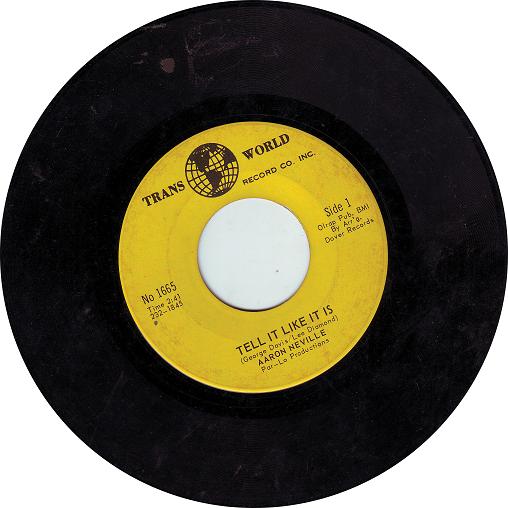
As illogical as it sounds, a million-selling record can actually bankrupt the company that manufactures and distributes it. Such was the fate for the hypnotic “Tell It Like It Is.” Prior to recording “Tell It Like It Is,” Aaron Neville was one of many hustling New Orleans R&B singers; “Tell It Like It Is” would become his signature.
Neville was born January 21, 1941, the third of four children, and was raised in the 13th Ward, initially living on Valence Street before the family moved to the Calliope Projects. As a youth, Neville listened to spirituals, doo-wop and the cowboy music he heard in the Western movies he saw at the local theaters.
Besides his parents, his direct influences included his uncle, George Landry, a.k.a. Big Chief Jolly, a merchant marine who played bawdy barrelhouse piano and masked as an Indian for Mardi Gras. Older brother Art was another big influence. Art fronted the popular Hawkettes, and Aaron often sang with the group. When Art was drafted into the Navy in the late 1950s, Aaron took over leadership of the Hawkettes.
His adolescence included several brushes with the law and a six-month stint in parish prison for joy-riding in a stolen car. Upon his release in 1960, rock ’n’ roll bad boy Larry Williams—who Neville befriended during his days with the Hawkettes—took Neville to a Minit Records audition supervised by Allen Toussaint. Impressed by Neville’s voice and his original material, Toussaint signed him, and Neville’s initial Minit release—“Over You”—was a local hit and briefly nudged into the national R&B chart. Subsequent Minit singles were less successful, and the label was sold to Liberty Records in 1963, leaving Neville without a contract. For the next two years, he divided his time between New Orleans and Los Angeles, running with Williams, who had a reputation as a pimp and drug dealer.
In 1966, Neville was approached by writer and arranger George Davis, session man/liquor salesman Alvin “Red” Tyler, and school teacher Warren Parker, who were partners in a new production company, Par-Lo Enterprises. Wilbert Smith a.k.a. Lee Diamond—a friend of Davis’ and former Minit labelmate with Neville—had a title for a song with a hook: “Tell It Like It Is.”
Davis agreed, but because Diamond was incarcerated before he could write any lyrics, Davis finished the song. Neville then went to J&M Studio to cut the song and three other Davis/Diamond compositions. Davis arranged and played baritone sax, Emory Thomas played trumpet, Deacon John was on guitar, Tyler played tenor, Willie Tee supplied the piano and June Gardner was behind the drums. Everyone involved knew they’d just cut a hit record.
Davis and Parker took the session to New York and were surprised that they found no takers. Finally, they formed the Par-Lo label and put “Tell It Like It Is” out themselves. They pressed 2,000 singles and signed a distribution deal with Cosimo Matassa’s Dover Records. To spur local sales, Par-Lo gave WYLD’s Larry McKinley—then the city’s top disc jockey—half the publishing.
Obviously, McKinley played the single often and other radio stations in the area followed suit. Dover reported selling 40,000 singles locally in just a week’s time. It didn’t take long for it to break in other markets.
The song would top the national R&B charts for five weeks and reach No. 2 in the pop charts early in 1966. Eventually, the single sold in the neighborhood of two million, and Par-Lo rushed out a Tell It Like It Is album. With a gold record, Neville should have had it made. Unfortunately, Par-Lo and Dover overextended themselves, granting their accounts terms that were far too liberal.
Matassa admitted his mistake to John Broven in Walkin’ to New Orleans:
“It was common that a distributor would get 300 free records if they bought a thousand. I was dumb enough to keep the freebies going after [“Tell It Like It Is”] was established. On “Tell It Like It Is,” on the books we sold over a million. What should have happened is after 150,000 we should have said, ‘The freebies are over, they’re 20 cents a piece now. You’re gonna pay the basic royalties and cost of manufacturing.”
Eventually, Par-Lo and Dover couldn’t pay their pressing, shipping, promotion and tax bills. The Internal Revenue Service seized all Dover and Par-Lo’s assets, and Neville wound up without a label and claims he didn’t get all his royalties from “Tell It Like It Is.”
“It was a bad deal made by people from New Orleans that didn’t know what they were doing,” said Neville in 1997.
“There’s still people out there pirating that [“Tell It Like It Is”] and they’ve been doing it for years.”