Theresa Andersson: All By Myself

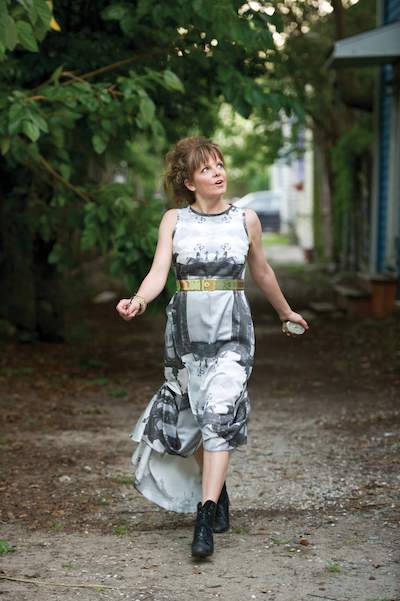
Theresa Andersson. Photo by Elsa Hahne.

Theresa Andersson. Photo by Elsa Hahne.

“Okay Theresa, walk toward me.”

Playback starts and Theresa Andersson begins walking in a secluded alley in the Bywater with a slightly distracted sense of purpose when Portland-based director Alicia J. Rose calls “Action.”

Andersson is shooting a video for the title track from her new album, Street Parade, at the Music Box, the musical art environment on Piety Street. She’s in the alley behind it when the song plays at chipmunk speed. She lip syncs at a similarly high speed; when the sequence rolls in slow motion in the finished video, she’ll appear to be singing normally. Street Parade is the follow-up to 2008’s Hummingbird, Go!, an album that signaled a meaningful change for Andersson. She arrived in New Orleans in 1990 and has undergone a number of musical incarnations since, each compelling but none exactly right. They seemed to represent the music she could make rather than her music.

“There was a time when I was trying to fit in in a pre-designed space, where I thought, ‘If I do things like this, I’ll find an audience,’” she says. “I’ve found that if I’m being me and being creative, I’ll find the audience.”

An invitation to tour Sweden in 2007 tested Andersson’s creativity because there was no budget for a band. She couldn’t see herself onstage by herself strumming a guitar alone, so she began to work with looping pedals and do more with less. She took her signature instrument, her violin. “I can strum it, I can bang on it,” she says. “I can play it with an octave pedal to create a bass note that, if I played it in the context of a band it may not be enough bass, but in context of the one woman show it’s exactly the right dynamic. Playing it with a slide. Layering it with voice and strings. You can pluck it. There are a million ways to approach an instrument that you wouldn’t normally do.”

Andersson turned to Swedish producer Tobias Froberg to work with her on her first album after that tour, Hummingbird, Go! She intended to record it with a band, but Froberg thought she should explore the musical voice that was emerging. The result was a more private album that celebrated New Orleans, but it was also more in touch with her Swedish side. She has lived in New Orleans longer than she lived in Sweden, but it’s still an important part of her identity, so much so that she released Street Parade in Sweden a month before it came out in the States. The process of building her songs herself in collaboration with Froberg has allowed that Swedishness to come out, Andersson says.

“There’s that streak in the Nordic music—you can hear it in Bjork, you can hear it in Ane Brun—that goes back to the folk roots that flop back and forth between the major and minor,” she says. “It really speaks to me. I love singing over minor keys; I think they inspire really nice melodies.”


“Note to self: Do not let the skirt fall into the candles.”

Andersson has made it to the door behind the Music Box and has to unlock it. This shot was going to take place near sundown when the light is perfect, but the timing was off and after one take caught a crew member out of position, director of photography Bryce Fortner says the shot has to be lit. Now she’s at the altar-like door with collections of candles on either side of it, and Andersson’s trying to save herself and local designer Amanda Deleon’s dress from harm.

It’s easy to think of Andersson these days as a truly solo artist, but Street Parade was a group effort down to its funding, which came through a Kickstarter project. She cut the basic tracks herself, but she brought in local musicians to contribute horn parts. “Ray Moore came in because I needed a horn player that could play very good time, and he’s amazing.”

She was energized when she started recording last summer because the new album had been some time coming. The effort to learn to perform well with the pedals was grueling, partially because of the number of parts she generates for each song, but also for the speed with which she builds them. In New Orleans, Drums and Tuba used looping pedals, but their compositions built more slowly, and though Andrew Bird’s songs are pop-oriented, they still take longer to come together onstage than Andersson’s, which stay pretty close to their recorded, pop-friendly lengths.

“It was so much detail to keep track of,” she says. “I literally had car wrecks and headaches and bruises; it was brutal. Touring took incredible focus and my writing brain shut off.”

Back in New Orleans for Mardi Gras 2010, inspiration came as one parade ended and she was waiting for the next one. That sense of being between things resonated with her, so much so that she came up with the album title and began writing. A return to the road spiked that bout of creativity, and she remained blocked until she resolved a lingering baby issue. She wanted to be a mother, but she had anxieties about how it would affect her career. “I chose not to think about it,” Andersson says. “Once [Elsie] was conceived, I was like, ‘Alright, no turning back now,’ and it was like a weight was lifted off my shoulders.”

She then wrote with new-found freedom, recording demos of her songs in GarageBand, often singing parts that she envisioned going to other instruments. “It was a natural evolution of working with the pedals,” she says. “When I write on the pedals, I start with my voice. My voice has always been my first instrument. It’s like the brain; I was using like four percent of what it could do.”


Theresa Andersson at the Music Box. Photo by Elsa Hahne.

Theresa Andersson at the Music Box. Photo by Elsa Hahne.

“Seriously, can we move these candles?”

It’s dark now and Andersson’s still at the Music Box door. The mosquitos are oppressive, but she patiently puts the key in the lock, looks up when the lantern goes on, then goes in, but the process isn’t always smooth because the door sticks. The fear of burning a designer dress is still on her mind.

On Street Parade, Andersson once again turned to Jessica Faust, editor of The Southern Review, for lyrics. Faust has known her since 2002. She’s married to Bryan Spitzfaden, who collaborated with Andersson’s husband Arthur Mintz on numerous projects. When Andersson asked Faust to help her find a female poet who could write lyrics for the songs on Hummingbird, Go!, Faust put a few of her own in the pile at her husband’s urging. There were a few songs that Froberg had to write because Faust couldn’t find her way into them, but that wasn’t the case at all for Street Parade. “I think it worked better on this album because we had a closer understanding of each other,” Faust says. “We have a lot of shared experiences, though we’re very different.” She is five years older than Andersson, a mother and a professional woman, so she was familiar with the anxieties and feelings that were motivating Andersson.

This time, Andersson provided her with completed tracks with working titles, which made the writing much easier. “She’s so good at creating visuals with the music that it was immediate what I wanted to paint with the songs,” Faust says. “She didn’t have to give direction because there was a tone to each song that gave a very distinct perspective for how it would feel.”

Massed drums and horns are a big part of Street Parade, but she tracked the horns part by part. “I had painted a very panoramic picture in my head of what I wanted the sound to be like beforehand,” Andersson says. “But I had never written for horns before, and I felt more comfortable working with people one-on-one because the sound of each instrument is so new to me.

“Tobias gets really inspired in the moment and he can feel like, ‘Alright, Rick Trolsen, just go wild on your trombone here’ and he would get him to create this crazy part that was perfectly offset with all my pretty, weaving lines there. Mark Braud was playing this low note that was like a sub-note on “Hold on to Me” in the chorus. I was playing piano with pitch shift and all kinds of weird things, but it’s the trumpet underneath—it almost makes it sound like a didgeridoo. It was so awesome to have this experience with all these musicians and mold the record as we were going.”

That quest for something awesome is an important theme of Andersson’s art these days, and it found expression in the Krewe of Muses parade this year. The video for “Hold on to Me” documents her ride atop a giant puppet swan that hovered above the parade accompanied by a marching band and dancers.

“I contacted [Muses] and explained that it’s been a lifelong dream of mine to actually march and to put together a marching band,” Andersson says. Muses was interested and soon she had a team of 50 to 60 people working on the project. “She and Arthur have an incredible way of when they say, ‘Hey, we want to do this,’ they’re such great leaders that you let go and say, ‘Okay. This seems impossible, but we’re going to do it,’ says John Michael Rouchell, who was part of the band. “They’re always doing something creative and interesting and people want to buy in.”


Days after the shooting of the video at the Music Box, Andersson returned to actually perform in it. “I got to play the loop pedals with one of the stations, recording on to them as the recording went on then using them in this rhythmical way,” she says. “The whole thing is this organic machine that works together. It was a privilege to be in there.”

The Music Box, like the Muses parade, highlights the spirit of play that underlies Andersson’s art these days, and she brought it to the performances that introduced Street Parade this spring. She will tour the music as a one-woman show, but for a handful of gigs, she went from a one-woman, tech-heavy show to a 12-piece band that included her husband Arthur on drums, three more drummers, Rouchell on guitar and bass, and a six-person horn section that included members of the Local Skank and Brass-a-Holics. She had her pedal rig set up, but the arrangements often didn’t call for much looping. Instead, she seemed to revel in the pleasure of having a community around her, one she could interact with or leave to do its own thing, as often happened when the women in the horn section developed their own dance steps mid-song.

Andersson played some songs from Hummingbird, Go! that didn’t loan themselves to a looped arrangement such as “Japanese Art,” and the big band drastically changed the feel of some songs. The wary “Fiya’s Gone” turned celebratory with exhilarating horn stabs, and the unreleased “Orpheus” had the rambunctious energy of a marching band.

The big band was an idea that developed on the fly. Just days before the band was to play a warm-up gig in Mobile before playing French Quarter Fest on Sunday, she called Rouchell. The initial plan had been to go with loops, horns and marching band drums, but Andersson decided she wanted a live rhythm section and tapped him, Mintz, and keyboard player Joe Shirley. Rouchell had been in her band before, but he hadn’t played her recent material. “They’re tricky, quirky tunes, so I had to learn her sense of linear arrangement, remembering ‘Oh yeah, second pre-chorus she likes to longer to build up tension before the second chorus.’ ‘A lot of the time the second chorus is doubled,” he says. But she gave him space to be a musician. “She trusted me. ‘Listen to this tuba part and go off of that, and lock up with Arthur.’”

Still, “this band was a treat for the city,” Andersson says. She’s already thinking about how to adapt Street Parade for her one-woman show.

“It comes down to building the show based on atmospheres,” she says. “I think of the set as a whole and more what I want the set to do and where I want it to go. That makes for some re-writing of certain songs or re-arranging of certain songs. The songs from Street Parade were actually written for a big band, and not all of them translate well on the loop pedals, but I ran into the same thing with the last record too.

“Now that I have some experiences working with a full band, I have some other ideas for how I can approach songs like ‘Injuns’ and ‘Street Parade.’ I’ll be sampling the record player, and instead of having the horns blaring, I’m using horns from a record.”

The pursuit of personal music paid off for Theresa Andersson, and it’s opened up new worlds for musical exploration. It’s made her daring and edgy and given her a stronger, clearer artistic persona—one that gives her license for further exploration.

“When you throw yourself into something wholeheartedly and figure that people who like what you do will find it later and everything will fall into place later,” she says. “Then I felt free to really just go and create.”