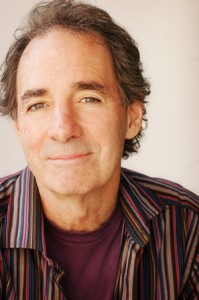
It’s easy for New Orleanians to be skeptical under the best of circumstances, and even more so where celebrities are concerned, but Harry Shearer and Judith Owen don’t just have a condo here; they’re connected to the city. Owen records here, and Shearer is outspoken in his criticism of the government— Bush and Obama administrations—in their unwillingness to accept and address the failed levees that flooded New Orleans, writing a blog for HuffingtonPost.com. When Spinal Tap decided to shoot the DVD Unwigged and Unplugged, Shearer approached Loyola film studies professor Jim Gabour to shoot it. For the video, Shearer, Michael McKean and Christopher Guest played the songs they made famous as Derek Smalls, David St. Hubbins and Nigel Tufnel in 1984’s This is Spinal Tap, but this time they appeared as themselves and were less rigorously adherent to heavy metal conventions. For the occasion, “Sex Farm” was remade in New Orleans’ image as “Funky Sex Farm.”
Shearer and Owen perform their Holiday Singa- Long here. What started as a party in their Los Angeles home has grown into a performance that returns for its third year to the Contemporary Arts Center December 18-19 with guests Leah Chase, Jon Cleary, Phillip Manuel, Tom McDermott, the Pfister Sisters, Matt Perrine, David Torkanowsky and more. It’s a funny, irreverent show that typically ends with a sung and pantomimed version of “The Twelve Days of Christmas.” At one show last year, a woman leapt on to the rows below her while singing “ten lords a-leaping.” “I’ve been really impressed,” Shearer said by phone from Los Angeles, “with how many people come up to me in town and ask, “You are going to do that again, aren’t you?”
Why did you do The Tap Unwigged?
One, it was the 25th anniversary of the movie and we wanted to do something. The economy yelled at us, “Don’t do a bigass rock and roll tour,” and we had always had this in our back pocket. We always liked them, and people always seemed to like them, so we thought, “We always said we were going to do it; now’s the time.”
Today, what’s your relationship to Derek Smalls [Shearer’s character in Spinal Tap]?
I have a lot of the history in mind, the parts he’s chosen not to forget. I realized a year or two ago, I haven’t played any character quite as much in my life as Derek. We are joined at the unhip, I guess.
Do you think like Derek? What’s it like having a 25-year relationship with a character?
I don’t think like Derek except when I’m in wardrobe. I have to inhabit him to think like him; otherwise I’m sort of an observer, which I think is the sane approach. Somebody came up to me the other day and said that we’d met, and I had denied I’d ever met him because I met him as Derek. That sounds a little Andy Kaufman to me, but it’s right on the edge of where I want to be.
You don’t do many full, costumed Spinal Tap shows anymore.
Right, we did two this year, we did the one night world tour, at Wembley Arena, and then we did a performance at the Glastonbury festival in England in front of 130,000 of our closest friends. But that was it. Partly because we’ve done it. The three of us are more interested in doing new or different things than going back and tracing the same thing over and over. Also, we haven’t figured out how to make serious money off of Spinal Tap. I know I don’t speak for everyone involved in the business side of it, because I think they have, but we haven’t.
You spoke at the Rising Tide Conference, where you addressed the media coverage or lack thereof after the storm. You said we had lost the media war. What did you mean?
I think what really put the period at the end of that sentence was when Obama came down and called what happened to New Orleans “a natural disaster.” There was no more cogent, poignant, damaging proof that we’d lost the media war than when the President of the United States mischaracterized what had happened in New Orleans because that was the popular media view. And at that point, you just go, “Yeah, we lost.” I feel I’ve done my little part on my radio show and in The Huffington Post to try and counteract it, but after the president did that, I decided to do a feature length documentary about why New Orleans flooded to see if that might break through. Barring that, we have to deal with [the fact] that most people think it was a natural disaster. “Why are y’all living below sea level? Why should I help you rebuild if it’s going to happen again?” and blah blah blah.
Why did the media get the story so wrong?
I’m a real believer in Occam’s razor, which says the simplest explanation that coincides with the known facts is the one you choose, and for media behavior, always look at logistics first. The logistics of the early days of the disaster were, “What’s near the I-10? Oh, the convention center and the Superdome. We’ve heard of them and can get to them. And oh, there’s a good story here, that’s the story.” When you filter that through the liberal New York sensibility of the people who give us our news, they didn’t see any reason to go further, and ask are there any other people that are suffering not within freeway distance—in Gentilly or Lakeview or St. Bernard? They didn’t ask those questions; they had their story. And of course, there was this big ol’ thing in the gulf on weather maps for days that told them what the story was. It was a hurricane story. The rest of the story leaked out in dribs and drabs over the next few weeks and months as the teams from LSU and Berkeley came around and poked through the mud, and [the media is] loathe to reexamine the template they assumed the story to be. Once they decided that’s the story, it’s one of the hardest things to change. It’s very hard to fight that, for the reporters on the ground, but of course the reporters weren’t on the ground. They weren’t in St. Bernard or Gentilly or Lakeview or Broadmoor, so the editors were getting no contrary evidence to their predetermined view of the story. Once that’s in, it’s done and done. They pack up, move away, and then the story has new twists and turns, but they’re gone, on to the next thing.
I did ask Brian Williams nine months later, “We know you care and are smart. You were in the Superdome for two nights, and that’s not nothing, but how come people watching your broadcast for nine months don’t yet know why New Orleans flooded?” I just found somebody who took footage of him saying, in front of a bunch of people at Tulane, “We just believe the emotional stories are more compelling for our audience,” meaning we’d rather have endless footage of suffering people than explain to our audience why they were made to suffer. I think those two things go to explain why we lost this battle.
I wondered when Ed Blaklely said New Orleans has a race problem if the constant images of poor African-Americans outside the Superdome and convention center made it easier for Americans to distance themselves from the problem.
Absolutely. It became a marginalized race issue because people weren’t able to see all the white people standing on roofs in St. Bernard, going through the same thing. This is probably overstating by a hair, but it was criminal slander to depict it that way. Too many people of all races, colors and incomes shared their suffering to have it be characterized and marginalized. And to say marginalized, I don’t mean the people that we saw at that Superdome weren’t undergoing horrific circumstances, but I think it was used by people who didn’t want to help us to say, “It’s just those people,” but it wasn’t. It was a community-wide disaster that needs to be recognized and treated as such.
One of the things I found most offensive was the lack of interest in getting it right…
That’s right. It’s like that guy standing in the CBD and saying, “I’m in the French Quarter.” Anything in New Orleans was the French Quarter.
That was really hard to deal with. And the overriding sense that these were poor dumb bastards who didn’t know enough to get out of town, and when it really comes down to it, it’s kind of their own fault.
Right. What was doubly offensive to me, was that having gotten the story so wrong, they proceeded to pat themselves on the back about how gutsy they were in covering the story. That makes it hard to keep dinner down.
So have you laid down the Huffington Post blog now?
No, I’m still at it. Cain Burdeau had a great post with a quote from a guy from the Corps of Engineers. Oddly enough, he was bragging on the fact that they were doing this big project on the West Bank and he, the guy from the corps, said, “Well, the East Bank had a complete system that failed; the West Bank didn’t have a complete system to fail.” (pause) Well now we do, dude. Thank you. Now the failure can be community wide, thank you. No, I haven’t stopped, but my focus for the next little while will be on putting this documentary together. If we get all of the people who I want to be a part of it and do it right, and with the 5th anniversary where the national media can’t help itself, we could get something. I don’t hold out a lot of hope, but I just have to do it.
We could chew on this for hours, so let’s talk about Christmas. It looks like you get more or less the same guests yearly.
I think because this grew out of what we used to do in our house, we do this in a bunch of cities and for each one we try to have it be people we know, who are really good musicians but also friends. It has a family aspect as a result, and we really like that.
Last time I talked to you about the Christmas show, we talked jokingly about your relationship to Christmas songs as a young Jew.
You can’t live in American culture without hearing them. Unless maybe if you were an Orthodox Jew living in Brooklyn, you could be insulated, but my parents were very not orthodox, and liberal, and I was living in the middle of Los Angeles, Hollywood, so I was exposed to as much Christmas music as anybody. There was some I thought was treacly and horrible, and some that I thought was kind of cool.
What was cool? “
The Christmas Song” by Mel Torme— “Chestnuts roasting on an open fire,” as most people know it. “Carol of the Bells,” I always liked. Those were my two favorites from when I was a kid. I remember there was a Les Paul and Mary Ford album that I really liked.