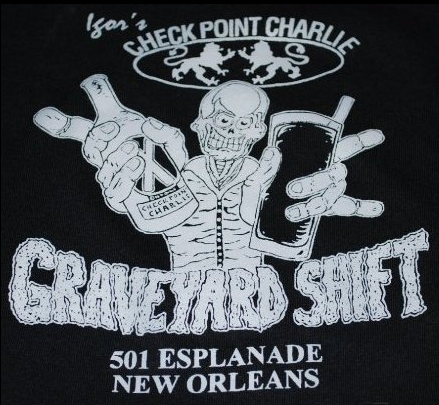
Yeah, this is not a joke: Check Point Charlie is a gone pecan.
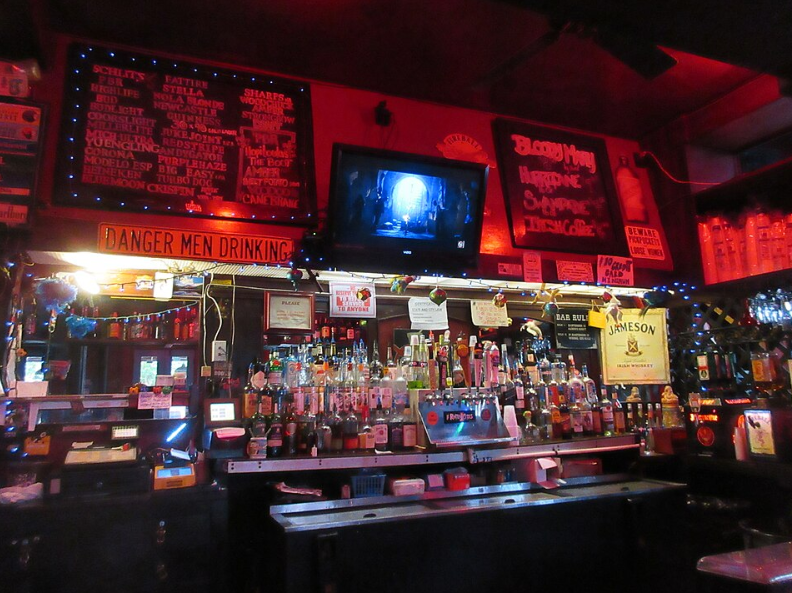
Esplanade Avenue is a dividing line, the formal border between the French Quarter and the Marigny, and for 37 years, one of the more useful things on either side of it was the bar at the corner of Esplanade and Decatur. Check Point Charlie was not precisely in either neighborhood; it occupied the seam—this turned out to matter. The bar served the Quarter’s late strays, the Marigny’s musicians who lived within walking distance, and the population that exists in every city but finds particular density in New Orleans: the people for whom the available hours are the hours nobody else is using. It was open all night because New Orleans operates on strange hours, and some places need to stay open for them.
 The bar had a laundromat in the back. This is the essential detail, the one that keeps appearing in every account of the closure because people understand instinctively that it is the key. The laundry was not a gimmick; it was a feature, and the distinction mattered. You showed up after midnight with a bag of clothes and no particular plan, put your quarters in, and sat at the bar while the machine ran. A band was probably playing. Nobody asked what you were doing there, which is, after all, the thing that matters at 3 a.m.
Check Point Charlie closed on Tuesday March 24, 2026 after 37 years. The announcement came at 11:43 in the morning, five lines on the official Facebook page:
“Welp… We had a good run. However, it’s time for us to move on… Thanks for all the memories ya’ll. Check Point Charlies: 1989-2026. RIP. No. This is not a joke.”
 Staff learned about the sale the same morning it was announced. There was no last call, no chance to gather, no final show. The bar’s former manager, who had run the place for a decade and had spent years afterward trying to preserve it as a music venue, wrote from the official account that night. “My sadness is overwhelming.” Four words. She had made the case for the room; the owners had decided otherwise; the building was sold and that was the entirety of the transaction.
The corner of Esplanade and Decatur has its own history, distinct from the Quarter across the street and from Frenchmen Street around the corner, though never quite separable from either. In the 1980s, Lower Decatur became a haven for the punk and goth scenes that had no natural home in the rest of the city. Check Point Charlie opened in 1989, precisely when that scene needed a room. Frenchmen Street was developing at the same time, as musicians fled Bourbon Street’s carnival economy in search of somewhere people were actually listening.
But what Lower Decatur offered was different from Frenchmen: not a music district, but somewhere to be when the music stopped, somewhere to be at 4 a.m. when the show was over and the laundry needed doing and there was no reason to go home yet. The Interview with the Vampire crew used it as their base during filming, spending early mornings there after wrapping because, as one of the film’s assistant directors later recalled, it was a place where they could feel at home. The bar never traded on this. That was also characteristic.
 After Katrina, the Marigny changed. The neighborhood had always been working-class and bohemian in roughly equal measure; after 2005, the rents went up and the high-priced real estate followed, and the bohemian geography of the city shifted in ways that are still unsettled. A 2020 study ranked New Orleans fifth among the most gentrified cities in America. The tourist economy that had always concentrated on Bourbon Street began radiating outward, first to Frenchmen, which by the 2010s had become a destination in its own right, and then further along the same axis, following the rent. Check Point Charlie survived all of this, which made its ending, when it came, feel sudden—even though it was, in a way, the final step of a process that had been underway for 20+ years.
And yet the mechanism of the ending illuminates something the city has never resolved. New Orleans has the Historic District Landmarks Commission, the Vieux Carré Commission, and 14 regulated historic districts, more protection for its built environment than almost any American city. What it does not have is any mechanism for protecting the cultural use of a building once the building changes hands. A cultural district designation explicitly does not restrict an owner’s right to alter or demolish. The city can protect the façade of a building in the French Quarter; it cannot protect what happens inside. And so the places that sustain the nocturnal culture New Orleans has always embraced and sold as its primary commodity have no standing when the building changes hands.
 Check Point Charlie had no plaque and was on no register. The punk bands played there because they had somewhere to play. The Prostitutes. One-Eyed Doll. Weedeater. Shows that meant something to the specific people who drove from wherever to see them in a room where the cover was low and your quarter still worked in the washer out back. It was open all night because some places need to be, and in a city that has always run on strange hours, being open is its own form of rebellion.
That rebellion has been silenced for years, and not only here.
Carolyn Cushenberry had operated the First and Last Stop on Pauger Street for more than two decades when the building sold last October; she had no standing in the transaction. The First and Last Stop had been in continuous Black operation for over 75 years, and the corner of Pauger and Marais was where the Monogram Hunters held their weekly Indian practices and prepared their Mardi Gras suits, a tradition that predates everyone currently paying rent in the neighborhood. The Big Chief sat down and cried when he heard the bar was gone. Cushenberry lost the lease. The space has since been kept alive because Kermit Ruffins stepped in personally, which is not a system of protection so much as a community performing a miracle it cannot sustain indefinitely. Check Point Charlie has no Kermit Ruffins. The corner of Esplanade and Decatur is under new ownership, purpose undisclosed.