Clifton Chenier King of Louisiana Blues & Zydeco
Five days after the all-star Clifton Chenier tribute album A Tribute to the King of Zydeco won a Grammy Award for best regional roots music album, Smithsonian Folkways Recordings and Arhoolie Records are releasing a massive box set of Chenier’s original recordings.
Clifton Chenier: King of Louisiana Blues & Zydeco contains 67 tracks recorded from 1954 to 1983. The box set samples Chenier’s recordings for the Elko, Specialty, Chess and Zynn labels and, most of all, Arhoolie label. Unreleased in-concert performances also appear on the four-CD and six-LP retrospective, a project that marks last year’s 100th anniversary of the zydeco pioneer’s birth near Opelousas, Louisiana.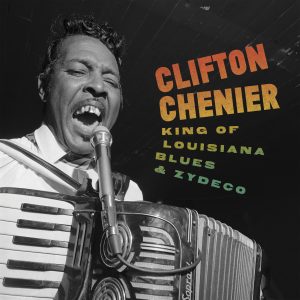
Adam Machado, executive director of the Arhoolie Foundation, produced King of Louisiana Blues & Zydeco. Machado won a Grammy award for writing the liner notes for Hear Me Howling! Blues Ballads and Beyond, a 2011 Arhoolie box set featuring music recorded by the late Arhoolie founder Chris Strachwitz in the San Francisco Bay Area in the 1960s.
“People liked it and Chris enjoyed the experience of us working together on a project of that scale,” Machado said from his home in Barcelona, Spain. “We started thinking about what else we could do. Of course, Clifton Chenier is a Mount Everest for Chris and Arhoolie.”
Although the Chenier box set didn’t become an official Arhoolie project for more than a decade, Machado followed the trail of Chenier’s life and career during visits to Louisiana with Strachwitz.
“I realized that the people who knew Clif in the 1940s and ’50s were rapidly disappearing,” Machado said. “I’d read the books and the liner notes written about him. I love Ben Sandmel’s book. But for me to understand the story in my own way, I had to talk to people who were down there [Louisiana and Texas], who knew Clif and played with him and danced to his music and maybe even grew up with him.”
Chenier’s son, zydeco musician CJ Chenier, gave Machado some leads. “Adam came by and stayed with me a couple of days, talking to different people,” Chenier said last week from his home in Houston. “I directed him wherever I could, helped him filter whatever I could—but for the most part he pounded the pavement, man, did what he had to do to get things figured out.”
“That’s how I got to folks around the town of Leonville [in St. Landry Parish],” Machado said. “Clif’s neighbors, and Mary Thomas, the cousin his parents adopted. For a couple of years, I was piling up these interviews, but they weren’t formally for a box set.”
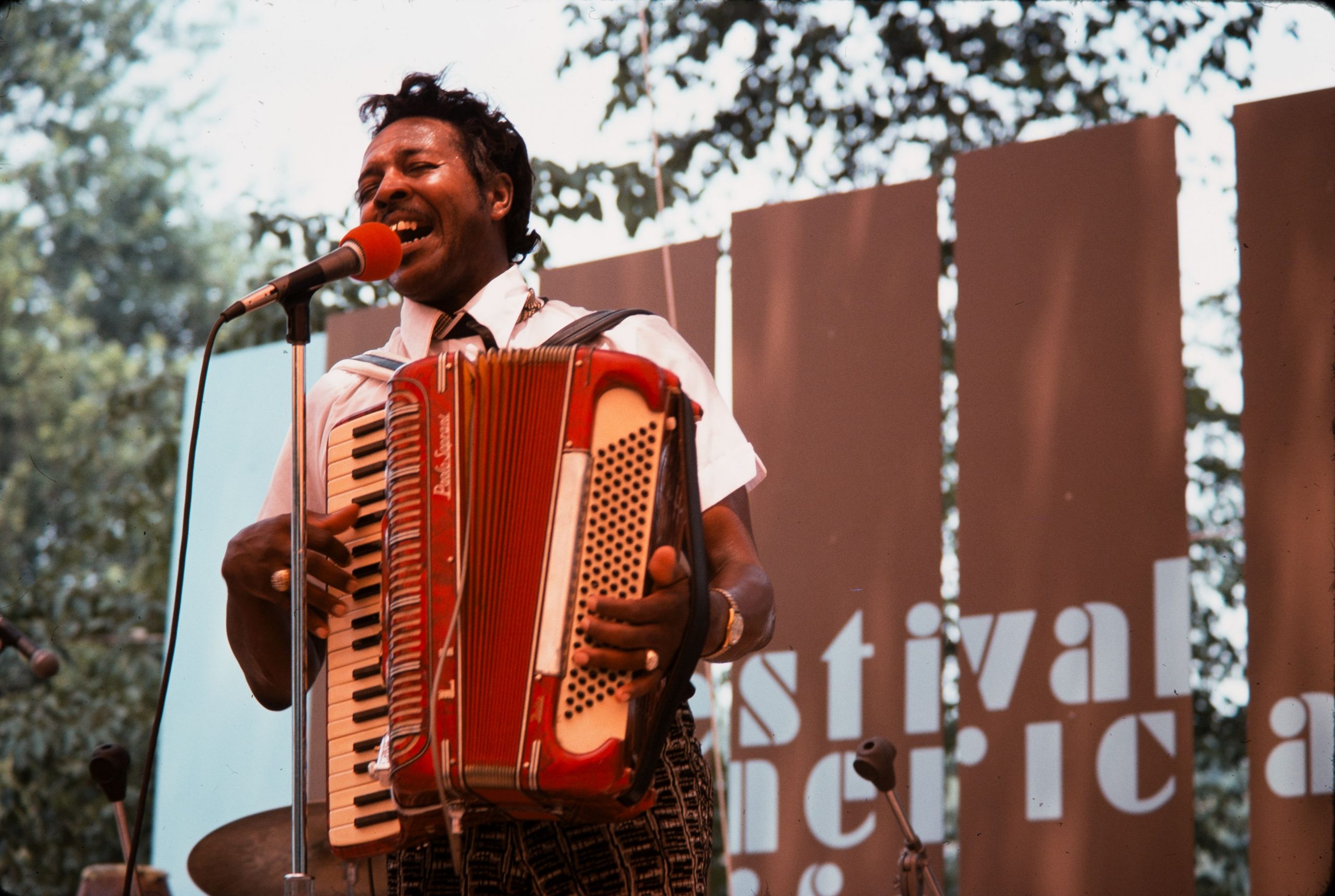
Clifton Chenier
Photo courtesy of the Smithsonian Institution
Between Machado’s and Strachwitz’s initial discussions about producing a Chenier box set and its release this week, Smithsonian Folkways Recordings purchased Arhoolie Records. Machado, the executive director of the Arhoolie Foundation since 2018, turned his attention to the Chenier box set a few years before Chenier’s centennial last year.
Machado selected tracks for Clifton Chenier: King of Louisiana Blues & Zydeco and wrote the 80-page biography of Chenier included in the box set’s 160-page book. The set also features dozens of photos and essays by Nick Spitzer and Herman Fuselier and a personal remembrance of his father by CJ Chenier.
Machado’s extensive research for the project yielded the earliest known live recordings of Chenier. During a visit with drummer Robert Murphy in Houston, Murphy gave Machado a recording of Chenier at the G&M Pleasure Spot in Lamarque, Texas, circa 1960. The box set features Chenier’s Pleasure Spot performance of the Jimmy Reed hit “Baby What You Want Me to Do” and a song from 1950 by Jimmy Rogers and Little Walter Jacobs, “That’s All Right.” Murphy, a high school teacher, made the recordings using a reel-to-reel tape recorder he borrowed from the school.
The box set’s tracks unspool Chenier’s recordings chronologically, beginning with his debut, 1954’s “Louisiana Stomp” and “Clifton’s Blues.”
“We licensed earlier recordings from Elko, Specialty and J.D. Miller to hear what he sounded like at the beginning,” Machado said. “We emphasized Arhoolie recordings because Smithsonian [Folkways] controls them, but also because we think it’s Clifton at his best.”

Clifton Chenier (right)
Photo by Chris Strachwitz
This week’s Grammy win for A Tribute to the King of Zydeco, which features the Rolling Stones, Lucinda Williams, Charley Crockett, Taj Majal, Steve Earle and more international names, is a reminder of Chenier’s worldwide significance.
“When an artist influences Mick Jagger or Bob Dylan or any of those folks,” Machado said, “they’re reaching many more people, because stars have a bigger platform than a guy playing according in southwest Louisiana.”
Even amidst the recent international attention for Chenier, Machado returns to the king of zydeco’s local Louisiana legacy. “Everyone I talked to who saw Clifton Chenier and his band in a room, they were overwhelmed by the power, the magnitude of his presence and music.”