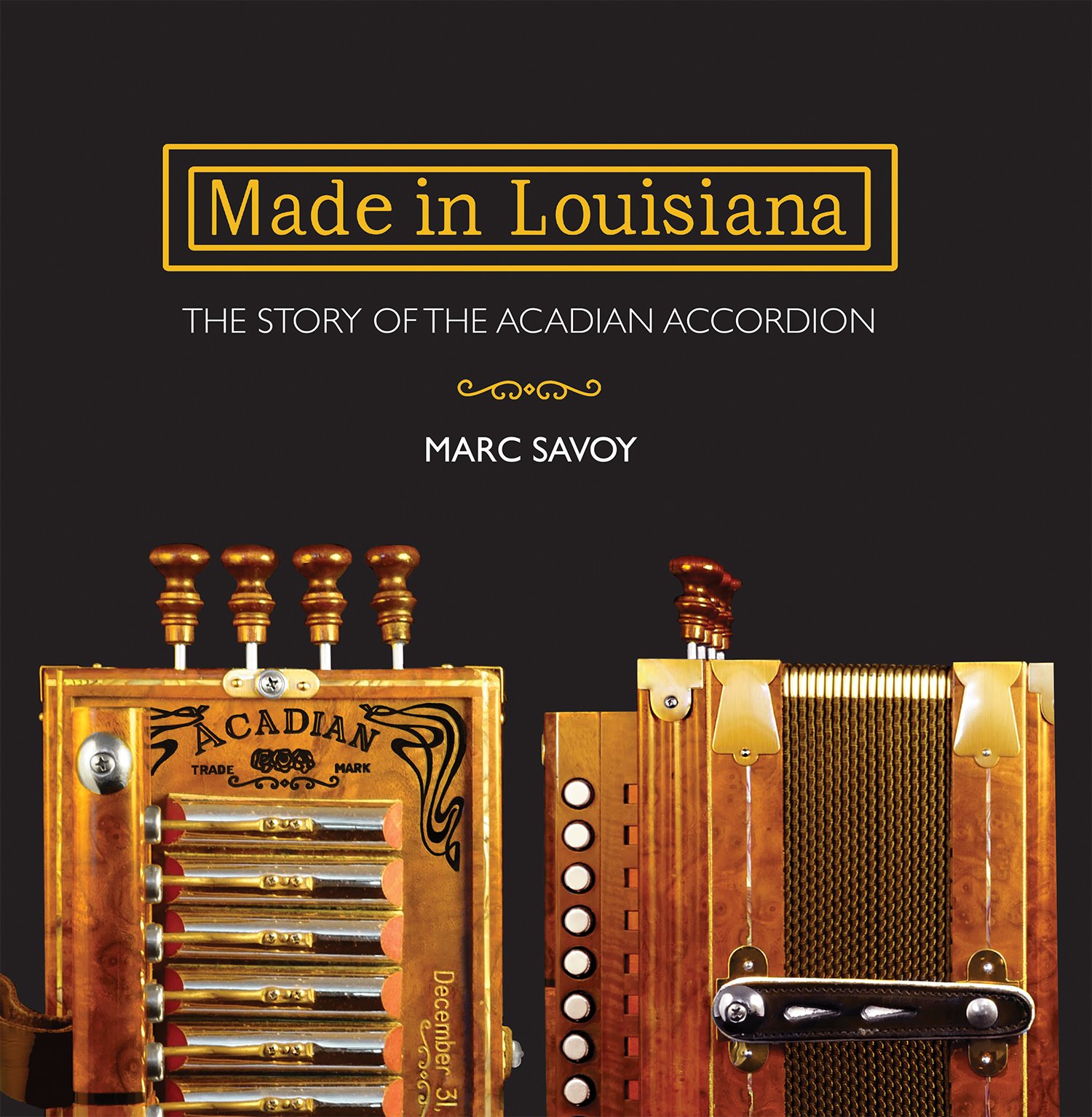
The autobiographical Made in Louisiana tells the evolutionary journey of how Marc Savoy, a farmer’s son and chemical engineering graduate, became the world’s foremost builder of the premier Cajun accordion, the Acadian. For anyone who has ever been enchanted by the accordion’s intoxicating sounds, let alone played one, this book is a must-read. For those fixated by Cajun music, it’s a safe bet that this book won’t be read just once.
 At age 15, Savoy repaired his first accordion and was soon making minor repairs on others’ accordions around the area. By 1960, the self-taught Savoy had built his first accordion. He didn’t like it, so he burned it. Undeterred, he built a second accordion, which was good enough to play at house dances. One night an attendee inquired if Savoy could build him one, thus, giving Savoy his first commercial order.
More orders followed and within a few years Savoy had filled his father’s outdoor kitchen with a sprawling operation. At his father’s suggestion to relocate the shop elsewhere, Savoy began constructing the Savoy Music Center east of Eunice, a site that became a cultural haven where people could buy accordions, get them repaired and play and socialize with others at jam sessions.
Savoy never rested on his laurels but continuously improved his accordions with design modifications, better parts and different quality woods and finishes of various colors, dispelling the notion that accordions always had to be black like the German-built Monarchs and Sterlings. Although he was self-taught, Savoy freely acknowledges learning from others, such as jack-of-all-trades Benton Daigle, who helped build the Center and offered breakthrough ideas on streamlining the assembly. Savoy incorporated ideas for improvement from renowned Quebecois accordionist Philippe Bruneau and admits the experience forced him to be an even better player, a startling revelation to anyone who has ever heard Savoy’s abundantly rich, ornamented playing.
Additionally, Savoy covers key moments in Cajun music’s transition from being something undervalued to becoming a cherished, cultural jewel. There’s the pivotal 1964 Newport Folk Festival where The Eunice Playboys received a rapturous standing ovation and how Savoy, Eunice Mayor Curtis Joubert and others established the Prairie Acadian Cultural Center and resurrected the adjacent, rat-infested Liberty Theater for live performances. In the 1960s, Savoy called it right with his prediction that Southwest Louisiana would eventually experience cultural tourism by roots-music aficionados appreciating Cajun music’s intrinsic, soulful beauty.
Besides Cajun-music history, there’s accordion history with segments written by Savoy and Jared Snyder, who contributed the introduction. Interestingly, both authors cite China as the place of the accordion’s origin.
Whether it’s the nitty gritty on how Savoy improved his accordions or guidelines on playing it, he freely shares his knowledge throughout this insightful book. Through his captivating writing, you get a sense of what rural Cajun life was like before it became cool to be Cajun. The copious black-and-white photos and stunning, full-color images of family, musicians, performances and even the various stages of accordion assembly are also invaluable in visualizing and appreciating Savoy’s unique and profound world.
Now 81 years young, Savoy often fields nosy questions on when he’ll retire. His stock reply is “I can’t retire,” which is usually followed by “Why?” And his next answer is always the same—”Because I never went to work.” Never stop dreaming, he concludes.