Unless you work from home, you probably have to drive to work, find a free place to park on the street, or pay a parking lot for space to park your car while you’re working. Now think about if you had to lug expensive, bulky or heavy equipment to your job every day from a parking place that could potentially be blocks from where you work. If you work at night, it complicates things even further because as we all know, it’s not necessarily safe for someone to carry valuable items to and from their job after dark.
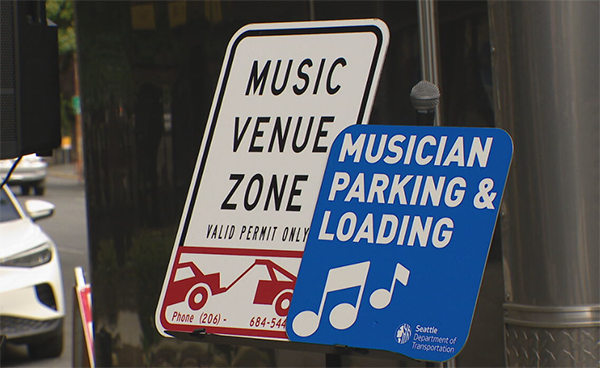
Photo: KOMO, Seattle
All of these issues plague musicians every single day. It’s particularly worrisome since many of them cannot park their vehincles close to their jobs on Bourbon or Frenchmen, or even close to the venues or bars where they may perform. It’s one of the many problems that musicians have to endure just to make a living. Think about all the musicians who play in venues, bars, music clubs and theaters around the city. It’s more often than not a detriment to their performing their jobs properly (yes, playing music is a job) and even arriving on time for a gig. For decades, musicians have had to try to find a place to park or even to stop to drop off their instruments at the placewhere they are playing. For decades, the city of New Orleans, which touts itself as a “music city,” has not addressed this problem for the musicians and bands who help to create the city’s reputation as a music city.
Here we have an article written by Julia Heath of the city’s Office of Nighttime Economy (O.N.E) addressing solutions that O.N.E.. has been working on to help to solve this issue, especially by using other cities’ model solutions. New Orleans has the ability to solve this problem, and it should be easy…
Musician Parking Is Treated Like Rocket Science (It Should Be a No-Brainer)
A universal music industry need that is almost universally ignored.
If you’ve ever watched a band load into a venue in a city, you’ve seen the problem.
They circle the block looking for somewhere, anywhere, to stop. Eventually, they park blocks away, or across the street, or they double-park and hope they don’t get ticketed. They haul guitars, lighting rigs, amps, drum kits, and merch through traffic, across intersections, and down sidewalks, dodging vehicles, pedestrians and cracked concrete. Sometimes they pay out of pocket for a rideshare just to get their gear to the door.
At the end of the night, they do it all again, but this time in the dark, carrying equipment and potentially cash from tips back to wherever they managed to leave their vehicle, sometimes alone and at risk of being robbed.
Musicians show up to work. They bring equipment. They need space to unload and somewhere to park. That’s it. That’s the problem. And yet, in city after city, this extremely normal operational reality is treated like a logistical impossibility.
Which is why it’s genuinely wild that Seattle is the first city in the United States to implement a true, functioning musician parking and loading program. Not because Seattle is uniquely known as a “music city,” but because this should be (and could be) the lowest-hanging fruit for any city that claims to support live music.
This Is Not a Niche Issue
Musician parking and loading affects every level of the live music ecosystem:
-
-
- A solo artist arriving in a personal vehicle with a guitar.
- A local band hauling drums, amps, and merch in a van.
- A touring act pulling up in a bus with a trailer.
-
Venues and musicians of all sizes face some version of the exact same problem every single day. And yet, most cities ignore these very real operating challenges and leave venues left to try to come up with their own (sometimes unsafe) solutions.
The result is predictable:
-
-
- Musicians circle the block looking for legal curb space.
- Gear gets unloaded in unsafe or illegal conditions.
- Artists get ticketed or towed while literally doing their jobs.
- Venues absorb fines, delays, and frustrated crews.
- Everyone begrudgingly accepts this as “just the way it is.”
-
And on top of being annoying, fines and parking tickets are expensive. One Seattle venue operator estimated that the city’s new musician parking program would save them around $45,000 per year in fines, delays, and other operational interruptions. That’s real, meaningful money lost simply because cities haven’t solved a solvable problem.
Seattle’s Music Venue Parking Zones: A Common-Sense Solution
Seattle’s Music Venue Zone program is exactly the kind of simple, common-sense solution every music city should have had years ago. Under the program managed by Virginie Nadimi, qualifying music venues can apply for a Music Venue Zone permit, which gives them up to three designated street spaces near their venue reserved for musician parking and loading 24/7. These are real curb spaces with signage and can be used for personal vehicles, touring buses, and anything in between.
How it works (taken directly from SDOT’s website):
-
-
- Each venue can get one permit, which allows three Music Venue Zones Spaces. The zones are available 24/7 for parking and loading for musicians and their crews.
- Vehicles in these spaces without a permit will be ticketed and towed.
- The permit costs $250 per year.
-
Like I said, this isn’t rocket science. It’s the City listening to feedback from their music venues and creating a solution.
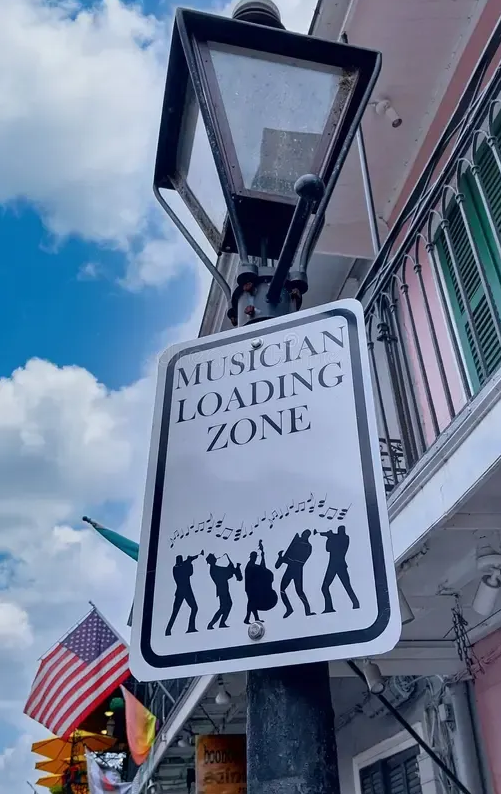
Photo provided by O.N.E.
New Orleans: When Policy Exists but Functionally Doesn’t Work
Back in 2019, New Orleans updated its city code to allow for Musician Loading Zones, which were supposed to permit a vehicle to park for up to 15 minutes for loading/unloading equipment before and after shows at venues with a Mayoralty Permit.
On paper, it sounds supportive. In practice, it doesn’t function the way musicians or venues actually need it to. To be clear, there are three Musician Loading Zones in New Orleans (and over 120 Live Entertainment permits currently active).
The program is built on a key assumption: that a venue already has a pre-designated freight loading zone that can also be used for musician loading with additional signage installed. But that assumption is hugely incorrect— most venues don’t have freight loading zones in locations that make sense for load-in. If they exist at all, they’re often placed based on general delivery needs, not where bands are actually entering the building and not where load-in can happen safely and efficiently.
Even for venues that do have a freight zone in an ideal place, there are still problems. After loading in, musicians need to move their vehicles somewhere else to park. So the process becomes fragmented: find the loading zone (if it’s available), hope no one is illegally parked in it, unload quickly, then re-enter the same unpredictable parking environment to find a legal place to leave the car for the duration of the show.
Like I said, there are three of these zones in New Orleans, and they aren’t even being used.
Wait, Why Can’t Cities Just Fix It?
On its face, this should be simple: identify a few curb spaces near venues, designate them for musician loading, and move on.
But in the world of City planning, permitting, and enforcement, everythinggggggg is complicated.
In many cases, even small curb changes trigger a formal curb use or traffic study process. That usually means issuing a Request for Proposals (RFP), hiring an outside consultant, collecting data on parking utilization, analyzing traffic flow, and producing a report often over the course of months, sometimes years. By the time a recommendation comes back, everyone better hope the individuals inside City Hall championing certain issues are still around, or the issue will again be ignored.
Then there’s the political layer:
-
-
- Nearby businesses may push back over the loss of a few parking spaces.
- Residents may raise similar concerns.
- Internal departments (transportation, permitting, enforcement, etc) may have competing priorities or conflicting interpretations of how curb space should be used and might have a negative response to being asked to add a new responsibility to their plate.
-
None of these concerns are inherently unreasonable (sometimes), but taken together, they create a process where a relatively small, targeted fix gets treated like a major infrastructure decision. And that’s the disconnect. Because while cities are studying, debating and negotiating over a handful of curb spaces, musicians are still double-parking, unloading in unsafe conditions, and getting ticketed for doing their jobs.
This is where confusion and prioritization intersect. Policymakers don’t always fully understand the day-to-day realities of live music operations, and because the issue doesn’t feel urgent compared to other demands, it gets slowed down, studied, deprioritized, and then, sometimes, forgotten.
In Conclusion: This Should Be Easy
At the end of the day, this is not a complicated problem. Cities already manage curb space for rideshares, handicap parking, deliveries, construction, film production, parades, and major events. They designate zones, enforce rules, and adapt when something isn’t working. The idea that musician parking is somehow too complex to solve just does not make sense.
What’s actually happening does make sense, as frustrating as it is. Live music operations are misunderstood, deprioritized, and are at the liberty of systems that aren’t built to respond quickly to real-world needs.
But a functional program is not complicated! At the risk of oversimplifying, it really only needs:
-
-
- Designated curb space near venues, clearly marked.
- Predictable (probably annual) permits, with clear requirements and application timelines
- 24/7 access that reflects real venue load-in and load-out schedules.
- Clear outreach and education so musicians and venues know it exists.
- Enforcement training and alignment so the policy actually means something and if someone illegally parks in one of these spaces, it is dealt with.
-
None of this is radical or expensive (in fact, it could be used as a revenue generating tool for cities). It just requires cities to treat musicians like workers whose labor has physical requirements.
Seattle didn’t solve everything. But they proved that when a city listens, coordinates internally, and prioritizes an industry they say they value, something that has been treated as complicated for decades can be resolved with a few curb spaces, clear signage, and aligned enforcement. The bar really is that low, but until more cities meet it, musicians will keep doing what they’ve always done—figuring it out themselves, absorbing the costs, and navigating systems that weren’t designed with them in mind.