Brett Milano, John Radanovich and Michael Allen Zell reviews from Jazz Fest Day 4, Sunday, April 26, 2026.
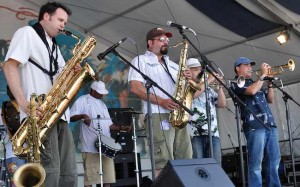
New Orleans Nightcrawlers. Photo by Clayton Call.
The New Orleans Nightcrawlers are one of the more flexible brass bands around. They have seven horns and use them all, so the sound might flow from old-school brass band to out-there jazz to classic New Orleans R&B—the only constant is that you can dance to all of it. They’re also a Grammy winner for the 2020 album Atmosphere (“We have no idea how that happened,” trombonist Craig Klein announced onstage). Sunday’s set was highlighted by a couple of tributes: “Heavy Henry,” in honor of Henry Butler, had the unpredictable rhythms that Butler was so great with, and “Fat Man,” for their late snare drummer, was occasion for a percussion extravaganza. Best of all was the Lee Dorsey tune “Great Gouge Mooga,” R&B at its most profoundly playful.
Irma Thomas’ set was a little special, and not just because she’s a local treasure going strong at 85 (she volunteered the age info during the set). This particular set played like it had been programmed by a hardcore fan—indeed, she said early on that she’d asked her band to suggest some catalogue songs to play. So, we got buried gems “Two Winters Long” and “Yours Until Tomorrow,” the latter a sexually frank number for 1964. Somebody up front got in on the action and yelled for “I Needed Somebody,” a great Ann Peebles cover she hadn’t sung in decades, and she obliged (she keeps an iPad onstage for such occasions). The hits were there too, and she clearly enjoys singing “Time Is On My Side” since Mick Jagger finally acknowledged, at Jazz Fest 2024, that the Stones took it from her (she proudly brought up that moment this week). She also went into her Galactic collaboration for “Where I Belong”—that being right there onstage. As she said to introduce it, “I never thought this old broad would still be doing this, but you’re not done with me yet.” Amen.
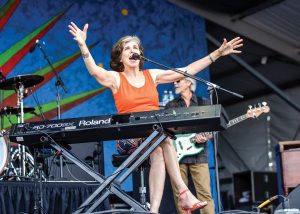
Marcia Ball. Photo by Josh Brasted
When Thomas made a dedication to her friend Marcia Ball, we took the cue and moved on to her tribute set at the Blues Tent. A Jazz Fest favorite for decades, Ball dropped the shocking news last year that she’d had an ALS diagnosis and could no longer perform. So, her traditional Fest set was reframed as a tribute—and a suitably all-star one, with her road band as the backup. Jon Cleary pounded through her preferred Fess tune, “Red Beans Cooking,” and Carolyn Wonderland added Ball’s name to the list of role models in “Shine Bright.” For the finale, the frontline of Wonderland, Sue Foley and Cindy Cashdollar traded off on “Let Me Play With Your Poodle.” Ball herself was present, watching from the sidelines and taking photos. But when Tracy Nelson announced, “Where Do You Go?”—a Katrina-themed song that they recorded together—Ball took her seat at the piano and sat in. When it was over, she nodded a smile to the audience, blew a kiss and walked off. File that with your most touching Jazz Fest moments.
David Byrne’s current show suggests what might have happened if Talking Heads had done another tour after the one immortalized in the movie Stop Making Sense. The new show carries that inventive staging to another level: Everybody onstage (including the drummers and keyboardists) has an instrument they can move around with, and it reimagines the look of a rock show with dance and movement. Byrne himself has really grown as a performer, relaxed enough to show warmth and tell a few stories. At 73 he’s never sung better, and he’s even better looking than he was in his 30’s.
Only problem is that he’s never found another band that can approach the magic of Talking Heads, and his recorded output has been seriously hit-and-miss in recent decades. The current show practically acknowledges that, since a good two-thirds of the songs, and virtually all the highlights, were Talking Heads songs. His band played them all faithfully, but never added fresh nuances the way the Heads always did when playing them onstage (the one exception being when guest St. Vincent, who’d played the previous Gentilly set, added a minimal but menacing guitar solo to “Air.”) It was Byrne himself who put the kibosh on a Heads reunion last year, saying that he’d moved on. Indeed, he has, but Sunday’s show raised the question of how far.
—Brett Milano
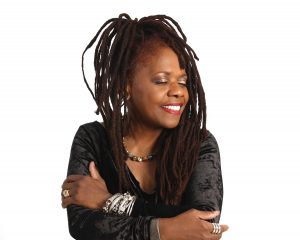
Catherine Russell. Photo by Sandrine Lee.
The Economy Hall Tent was the place to be Sunday afternoon when jazz shero singer Catherine Russell brought her quartet who played blues and modern updates of the great standards and lesser-known classics she loves to perform—by Sippie Wallace, Ray Charles, Etta James, Louis Jordan, Helen Humes, and Hot Lips Page. Jon Cleary sat in the audience, Charlie Halloran stopped by, and the Tuba Skinny band arrived early to catch Russell who has always been welcome in New Orleans several times each year. A dapper Wendell Brunious arrived on stage left with his trumpet, and together he and Russell traded choruses on “Gee Baby Ain’t I Good to You,” “A Monday Date,” “I Like Pie, I Like Cake,” and “’F Taint One Thing It’s Another,” the latter two from her just-out live album recorded at Jazz at Lincoln Center. Brunious supplied his adept solos to a handful of songs and reminded the audience of her father’s important place in jazz history as Louis Armstrong’s longtime band director and pianist. He may have added that her mother was a singer and multi-instrumentalist with Sweethearts of Rhythm and Mary Lou Williams.
For up-tempo dance numbers, Russell likes to have piano backing, but when she gets closer to gutbucket blues, she prefers to have her keyboardist Ben Paterson bring a deeper groove on organ. “The theme of my life,” she laughed, “is don’t be afraid to swing,” before she launched her own “Never Too Old to Swing.”
—John Radanovich
If you stop and observe, Jazz Fest has a unique ecosystem. It typically works incredibly well. But how? It’s not like NYC sidewalks where everyone is moving quickly. At Jazz Fest, you have fish swimming upstream, downstream, multiple side streams, some racing to a stage, others ambling along. It’s chaos that blends.
I think it works so well due to the shared love of music. No matter whether the Sunday crowd was there for Rod Stewart, David Byrne, The Isley Brothers, Jon Batiste’s Swamp, or otherwise, wet grounds from morning rain didn’t keep everyone from swimming along in sync. That’s a good statement on the day too.
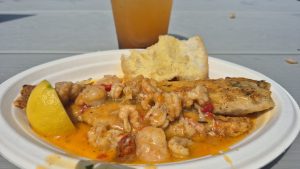
Trout Dizzy. Photo by Michael Allen Zell
Let it be said that the Trout Dizzy (or Trout Baquet if you prefer) topped with shrimp gets added to the upper echelon of must-have Jazz Fest dishes. Clearly, I’m not the only one who agrees. The Lil’ Dizzy’s lines proved the point, so I waited until I started the day at the adjacent Blues Tent. Witnessing a longer line for Café Du Monde’s coffee and beignets at that time put a smile on my face.
As did River Eckert’s performance. This wasn’t his first rodeo at Jazz Fest, but it felt like a triumphant statement that he will be an A1 mainstay for decades to come. Eckert is young, 16-years-old, but the pianist had the standing-room-only crowd repeatedly on their feet. He played largely from his brand new self-titled first album. “Red Beans” that felt like it’d been seasoned all day, what with a pro band including Eddie Christmas on drums, Jake Eckert on guitar, Aurelien Barnes on trumpet, and James Beaumont on saxophone. Eckert closed with a rendition of “Tipitina” that began as a classical ode and soon shifted into a jam that had the entire crowd up and cheering.
I hope David Byrne was backstage at the Gentilly Stage listening to People Museum. They are a band that is quintessentially Louisiana while being an entirely unique animal of their own making. A fresh DNA with something to say. A supergroup with choral vocals, horns and a beat that doesn’t quit. Their set was a blend of songs such as “I Am Yearning To Be Wild” from their just-released Dusk, a ballet along with those from the excellent album Relic like “Back To Myself,” “Sleep,” and the fuzzed-out bliss of “Relic.” Add a driving cover of Radiohead’s “Wild Fishes” and what more do you need?
You always know Erica Falls will put on a high-level show. She sure did, with a solid band, including Kyle Roussel on keys. “I’m bringing healing, love, and hope,” she said and delivered on her word. There were two particularly unique and beautiful elements to the performance. During a breakdown of Earth, Wind & Fire’s “That’s The Way Of The World,” she vocalized in turn with each of the five instrumentalists while they vibed in response. It was genius and the kind of thing that only someone with rich talent could pull off. I also loved this—with many bands, the background singers are just that. Tucked away and barely heard. Not at an Erica Falls show. Her background trio can sing, and you hear them. It was a quality ego-less move for Falls to take a beat for the trio to have their moment with a tribute to three legendary singers who’ve passed. Classy move all the way around.
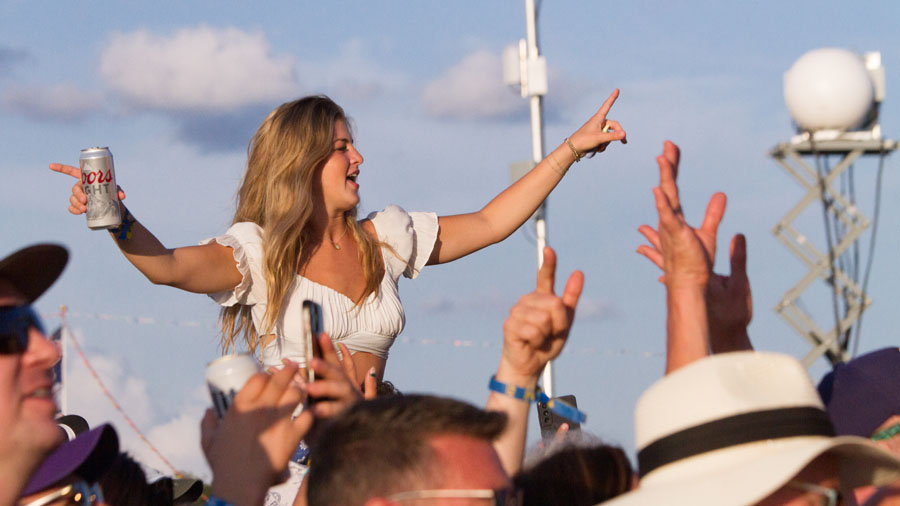
Photo by Brian Bennett
I love that Jazz Fest will often bring the best international performers to New Orleans. Last year, Youssou N’Dour was a marvel on the Congo Square Stage. On Sunday, it was the acclaimed Carlos Vives, one of the biggest names in Latin music. It was clear that Vives is Colombian, what with many a Sombrero Vueltiao (uniquely patterned straw hat), soccer jerseys, and flags throughout the packed lawn. Vives entered with “Quiero Casarme Contigo” and the crowd began a joyful sing-along. Vives popularized vallenato, Colombian folk music, blended with other styles, and it translated perfectly festive in a festival setting. Special guest Nidia Gongora and the occasional gaita, a long vertical flute, enhanced the set. Vives noted that, “The cumbia is the Colombian blues,” and added its connection to Louisiana zydeco before playing an incredible blend of the two.
Ronald Isley said, “I’ve got about 200 songs to sing for you today,” and we were there for it. He and brother Ernie entered to the The Godfather theme and the crowd erupted. It was a beautiful show of around a dozen classics including “Footsteps In The Dark,” “Atlantis,” and “Between The Sheets,” along with Frankie Beverly’s “Joy And Pain.” The sharply-dressed Ronald Isley blessed the crowd with his golden voice and particularly got into “Summer Breeze.” Ernie Isley’s jaw-dropping guitar tone was just as stunning in person. The Isley’s even went back to “Twist And Shout,” closing with a blend of “Shout” and James Brown’s “Funky Good Time” before the dancers tossed red roses to the crowd in a lovely gesture to end the day.
—Michael Allen Zell