Brett Milano, John Radanovich, John Wirt and Michael Allen Zell reviews from Jazz Fest Day 7, Saturday, May 2, 2026.
Saturday was something of a milestone for Jazz Fest: At $169, was the highest single day ticket price ever; and the first official sellout (aside from the one-off Rolling Stones day in both cases). Which meant the discomfort level could get especially high. My attempt to catch the Eagles was my first real experience with the claustrophobic packed-in crowds that covered every inch of the Festival Stage ground where the stage was at all visible. In a nutshell it wasn’t fun—and once you got yourself in, good luck getting out. It’s something of a miracle that nobody got hurt or collapsed.
All this for a band that, according to some convincing YouTube evidence, lip-syncs a good deal onstage. The chunk of the Eagles set I caught seemed mostly live, though Don Henley’s falsetto on “One of These Nights” was more than a little suspect. But it hardly mattered for a performance like this one, where every note was in place and the only goal was to sound just like the records—even when newcomers Vince Gill and Deacon Frey (Glenn’s son) were singing. Sure, some of the songs hold up, especially less obvious ones like the acoustic opener, “Seven Bridges Road.” But it all felt a bit canned, whether it actually was or not.
In contrast, Little Feat has an even longer history, has also weathered losses and changes, and is also down to three members of its classic lineup. But they truly came to play, and at the Blues Tent they infused oldies like “Oh Atlanta” and “Dixie Chicken” with fresh grooves and energy. Newest members Scott Sharrard on guitar and Tony Leone on drums (both sing) have slid right into the tight-but-loose Little Feat ethos, and they proved they belonged in the Blues Tent when percussionist Sam Clayton took the lead for Little Walter’s “Mellow Down Easy.” The set peaked with their local homage “New Orleans Cries When She Sings,” which flowed into the second line-informed “Fat Man in the Bathtub.” It was quirky, it was funky, it was the Feat.
Susan Cowsill has been a favorite of mine for ages, and her set at the Lagniappe Stage offered a few good reasons. Her voice is a thing of true beauty, having only gotten stronger through the years, and while she still has that Cowsill charm of classic sunshine pop, her songs aren’t afraid to reach deeper: This set included a newish, multi-part song about childhood and age that held quite a few shivery moments—as did her emotive reading of Joni Mitchell’s “Circle Game.”. At the same time, she takes the ’60s message pf peace and love seriously, doing heartfelt versions of the Troggs’ “Love Is All Around” and the Youngbloods’ “Get Together.” For the finale she was joined by singer/guitarist Vicki Peterson and guitarist Robert Mache—with her and drummer Russ Broussard, that made two-thirds of the Continental Drifters—plus John Cowsill on a pair of Drifters anthems, “Rain Song” and “The Mississippi.” There’s nothing like watching a good family reunion.
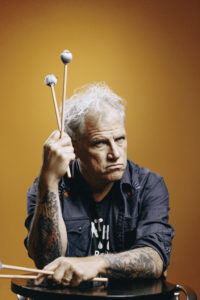
Mike Dillon. Photo by Noe Cugny
One of the most surprising sit-ins I saw this week was Mike Dillon playing vibes with the Honey Island Swamp Band. The HISB is one of those bands that tends to play the same songs in different ways with each Jazz Fest set, so the expanded lineup (also with horns and percussion) gave a fresh slant to standards like “Watch and Chain” and “Sugar for Sugar”; Dillion made his presence felt on the swamp-rocker “Head High Water Blues.” In this case everybody won: HISB got a loose-cannon soloist, and Dillon got a rock-solid band to work off.
—Brett Milano
Session piano and organ player Eric Adcock left home Saturday in Abbeville nervous about his first solo show. But he had little reason to fear his debut. A respected veteran sideman for Lil’ Buck Sinegal, Roddy Romero’s Hub City All-Stars, and the Mavericks, and like his more famous guitar playing brother C.C., he grew up surrounded by the work and presence of greats Bobby Charles, Fats Domino, Dr. John, and Marcia Ball. His three Grammy nominations for work on the recent Clifton Chenier tribute album attest to his prowess at the keyboard, and his special guest on sax Derek Houston told all his music friends for weeks in advance how excited he was for the show in the Rhythm Pourium tent. “He calls C.C. his sibling, but he calls me his brother,” Houston laughed.
In just a duo format in the crowded tent, the two buddies gave a lesson in boogie woogie from below the I-10 line (and a quick visit to Chicago with “Pinetop’s Boogie”), opening the show with the Dave Bartholomew and Antoine Domino classic “The Fat Man,” the DNA of all rock and roll that followed. The pianist took on the classic “Willie Fugal’s Blues” solo and accentuated the Cuban syncopation at the base of Fess’ composition. Adcock told the happy crowd that “I can’t leave here without doing a song by James Booker,” and added laughing “which may be a bad idea,” before he more than acquitted himself with Booker’s “Gonzo.”
Adcock’s own “Sugar Shuckin'” was meant to close the set, with its homage to all the great piano syncopators of Fess, Dr. John, and Bill Payne, but when he was told he could squeeze one more in, Adcock chose Bobby Charles’ “I Must Be In a Good Place Now.”
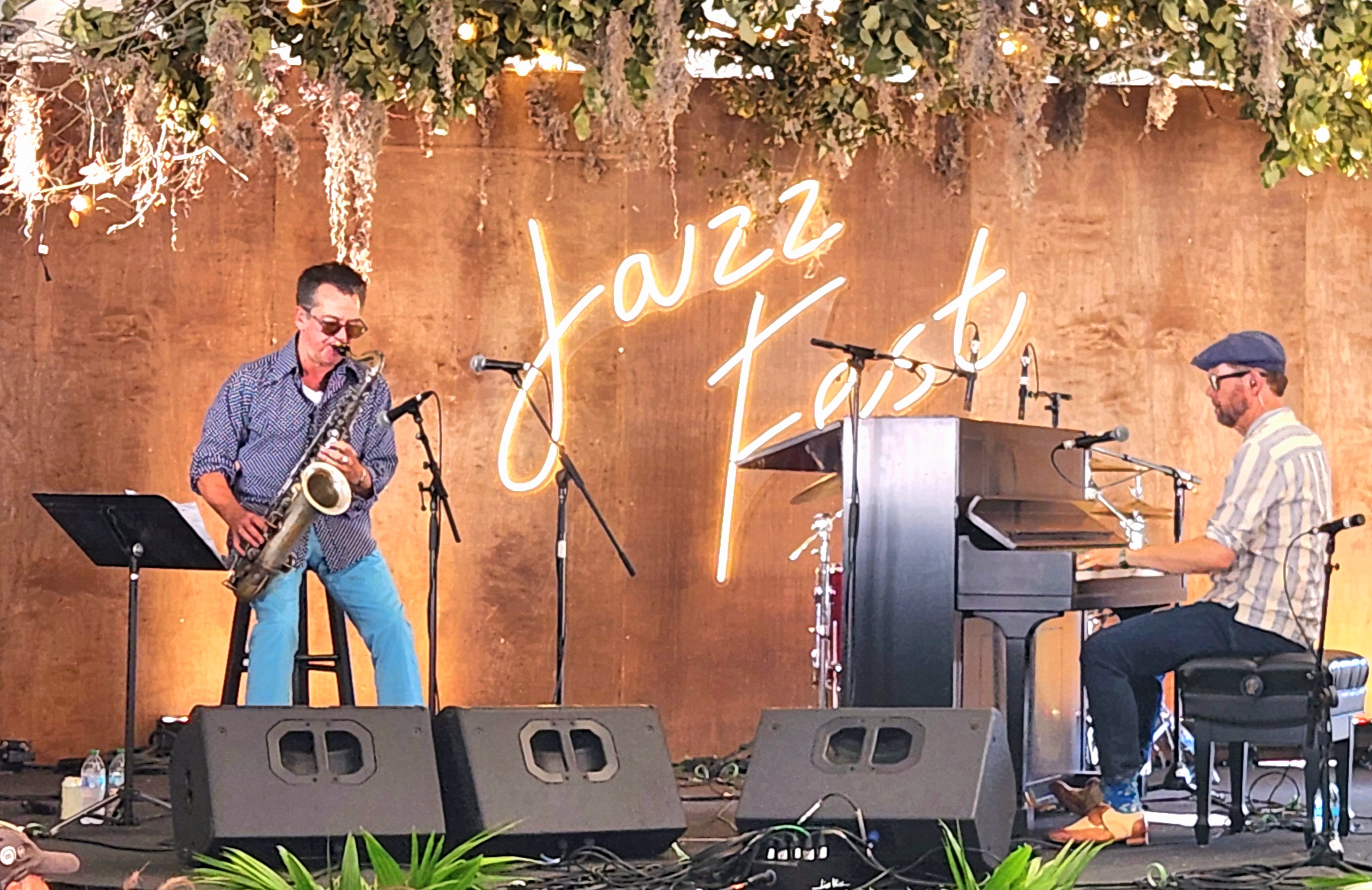
Derek Huston and Eric Adcock. photo by John Radanovich
Guitarist Larry McCray brought his fully satisfying Chicago style electric blues to town, fronting a simple rhythm section of bass, keys, and drums to great effect for fans of the blues. Born in Arkansas just across the border from Shreveport, McCray’s family moved for better work opportunities to Michigan when he was a boy, which put him just across Lake Michigan from the home of the blues legends, and within constant regional touring of all the bands from the Windy City. McCray’s authentic attack and songwriting has lured Joe Bonamassa into the studio as producer on Blues Without You and Heartbreak City, released on his Keeping the Blues Alive Records.
After a lifetime of playing Gibson and Fenders, McCray is now a big fan of Guild guitars and told Guitar World magazine that his newly adopted guitars “sound in between Fender and a Gibson.” It’s hard to argue with his logic when you hear what sounds he delivers live and in the studio.
McCray shot his “Last Four Nickles” straight out of a blazing cannon, and that hard driving sound followed with every song like “Never Hurt So Bad,” and his Bo Diddly beat in “Arkansas.” At times his instrumental shuffles can have a Jimmy Reed rhythm approach, as with “Keep On Loving My Baby” (written with Kirk Fletcher) and the scorching “Sloppy Drunk.” Although his overall sound and solos are influenced by the Kings B.B., Freddie, and Albert, McCray often adds a wah wah pedal effect to both his rhythm and lead solos, as he did on several throughout the show, and his closer, the instrumental “Buck Naked.”
On a stop along their final tour, Little Feat packed the blues tent with an excited crowd for Saturday evening’s closing. With three of the remaining original members of the greatest band in rock history, the Feat thundered loud and hard. It was the closest you could get to the magnificent live album Waiting For Columbus, when Lowell George, Paul Barrere, and Richey Hayward were still alive.
The current Little Feat play harder and more close to the original super group than you might expect, and the lead guitarist Scott Sharrad does an admirable job of filling the huge shoes of the late Lowell George vocals and adds longer rock leads. George was famously kicked out of Frank Zappa’s band for ignoring Frank’s rule of never writing songs with drug lyrics but then went on to write some of the greatest of all songs to mention weed, coke, and pills, and directly—not just in innuendo and secret code. Takett has continued in the vein by writing “Too High to Cut My Hair” after a long night with his wife in New Orleans.
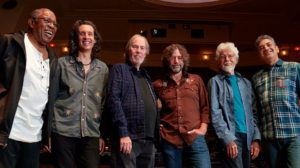
Little Feat. Photo courtesy of the band.
The adoring crowd sang the lyrics to all the greats: “Dixie Chicken,” “Spanish Moon,” “Willin’” and “Two Trains Running.” Payne dedicated “Time Loves a Hero” to all the people like Lowell George who were there in spirit. Their recent “New Orleans Cries When She Sings” paid homage to the city whose rhythms formed the majority of the Little Feat second line beat sound. And even though a mere little roach of a song, the beloved “Don’t Bogart That Joint,: might be expected to be the signal for the joints to be lit, it wasn’t until “Spanish Moon” when the weed started to waft.
By the time “Fat Man in the Bathtub” arrived, the ushers had given up trying to clear the aisles and the crowd loudly supplied the unforgettable “Dixie Chicken” chorus. Little Feat may have been scandalously passed over for entry into the rock and roll hall of fame all these years, but those who know are long aware of their absolute lock on the place of the greatest rock and roll band America ever created.
—John Radanovich
Singer-guitarist John Mooney, Saturday’s first performer in the Blues Tent, rolled through a solid set of what can now be considered traditional electric 20th-century blues.
Mooney kept his candy-blue slide on his left hand’s little finger for the whole show, even when he wasn’t using it, leaving it cocked and ready. And whenever he alternated between slide and non-slide playing, the transition was seamless.
Not straying from the blues, Mooney and his all-star New Orleans band nonetheless played a variety of blues styles—country blues; after-hours moody blues; a requisite cheating song; and a terrifically alive “Junko Parnter,” that New Orleans standard inspired by the former plantation known as the Louisiana State Penitentiary, a.k.a. Angola.
For “Junko Partner,” a song that has been performed and recorded by such New Orleans greats as James Booker, Dr. John and, recast as “The Fat Man,” Fats Domino, drummer Raymond Weber (Dr. John, Harry Connick Jr., Dumpstaphunk) drove the music expertly forward with his instinctive second-line beat.
Weber was one-third of Mooney’s backing trio, joining bassist René Coman (the Iguanas, Susan Cowsill) and keyboardist Dan Alleger. Mooney sat between them all, playing the two guitars he used during the performance. Singing in a high, reedy voice, he’s a gritty vocalist and maybe grittier guitarist.
Despite Mooney’s early start time Saturday, the appreciative Blues Tent audience reached capacity well before his morning show ended. “We really appreciate you coming out all these years,” he said at the end of Jazz Fest 2026 set.
C.J. Chenier’s 2026 Jazz Fest appearance follows last year’s many centennial celebrations of his late father and zydeco pioneer Clifton Chenier.
Like his dad, C.J. Chenier is a zydeco torch bearer. He mentioned his famous father, who’s still the “King of Zydeco” nearly 40 years after his death, a few times during the show and played Clifton Chenier and Buckwheat Zydeco classics, too.
As for C.J. Chenier, he’s a Grammy nominee and an annual attraction at Jazz Fest for decades. “I feel good,” the singer and accordion player said early in his set. “One of my favorite times of the year. [I’m] forty years at the Jazz Fest.”
Standing tall at center stage, the long-legged Chenier sang and, like his dad, played a keyboard-style accordion that’s much larger and, no doubt, heavier than the little Cajun accordions frequently seen at Jazz Fest. To Chenier’s left, that zydeco essential, the rubboard player, scraped hot, infectious rhythm.
Chenier and his Red Hot Louisiana Band picked up steam as the show progressed. Even a sad breakup song, “Turn Around and Say Goodbye,” got a lively zydeco treatment. But there was room for a slow song, the genuinely poignant, “I’m Coming Home,” highlighted by Chenier’s plaintive vocals.
As his hour-long set reached the final few songs, Chenier made an apropos announcement. “Well, what we go’ do right now, we going back to the bayou, back in the swamp. So, we go’ do some zydeco I learned from my dad. Let’s do the Louisiana two-step, baby!”
Chenier encouraged his Blues Tent crowd to “get on up.” They did, with seemingly everyone rising up and moving and crowding the Blues Tent aisles. And they stayed up through zydeco renditions of Ray Charles’ “I Got a Woman” and Hank Williams’ “Jambalaya.” Chenier told everyone he’ll see them next year.
It’s probably safe to say that that no original members of the pioneering Jamaican ska band the Skatalites were on stage at the group’s mid-afternoon Saturday Jazz Fest set. Members of the original lineup were active in the 1950s before forming the Skatalites in 1963. And the group recorded most of the band’s classic records in the early to mid-’60s.
The much younger lineup of musicians and singers at Jazz Fest played the Skatalites’ classic “Guns of Navarone” as well as “Simmer Down.” The first single by Bob Marley and the Wailers, the latter recording features the Skatalites as backing band.
The Skatalites reformed in 1983, performing with various lineups since then, including original members. The band’s current lineup stayed sonically true to the original band, reproducing the Skatalites’ punchy, powerful horn sound and distinctively propulsive ska beat. The setlist included a ska version of “When I Fall in Love” featuring singer Keesha Matrin, new songs and, the Jamaican music that followed ska, reggae music.
By the time the band reached “Guns of Navarone,” the Cultural Exchange Pavilion tent was a throng of bobbing heads and hopping and swaying bodies. In the year 2026, these modern-day Skatalites did a good job of approximating that highly influential Jamaican band.
—John Wirt
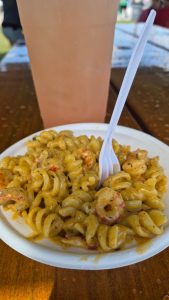
Crawfish Monica. Photo by Michael Allen Zell
For 43 years, Jazz Fest attendees have made sure to eat their Crawfish Monica at least once a festival. I started my day with a bowl of it, courtesy of Big River Foods. It was wise to order that and a Strawberry Lemonade immediately, because with a sunny sold-out day, the lines soon grew. Serpentine? Not quite. Stretching? Yes.
Ironically, Dee-1 is a big proponent of “getting it out the mud,” because his fans did so out of the literal mud to see him at the Congo Square Stage after Friday’s torrential rain. If you walk near any stage and see Jamal Batiste getting his drum kit ready and Yahel Yisrael doing the same with his keyboard, then the wise move is to stop in your tracks. Everything they do is A1. Dee-1 made it clear from the jump that, “This is a hip hop set where we celebrate love, unity, and community.” The rapper took it back a few years with “Against Us” and “You A Star,” slowing it down with “Born To Pay Bills.” He spoke on accountability and being an example, which puts himself in whole different lane, while the music hit well. Look for his new album The Shift and its namesake podcast to continue his expansion.
In most places, the Children’s Tent would be a cutesy place for forced smiles. In New Orleans, though, this is the spot where you see tomorrow’s stars today. The Guardians Institute describes its charge as “service to our community through education, the preservation of New Orleans’ indigenous cultural arts, and traditions of the African Diaspora.” They do all of this and put on a great show as a result. One particularly powerful moment was when Denise Frazier brought up each of the kids to speak on who they wished to honor today. It was a beautifully simple yet effective tribute to ancestors.
After this blessing, I decided to wander and allow open ears and discovery to lead the way. The answer was church a day early in the Gospel Tent with a powerful performance by Grammy-winning Akia Nevills and her group Grace Unlimited. The standards of “It Is Well” and “Oh Happy Day” hit right, while Nevills’ own “Shelter” shined bright. Nevills can do anything she wants with the mic. Make no mistake of that.
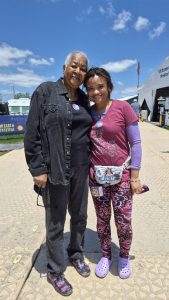
Dodie Smith-Simmons and Chantell Nabonne .Photo by Michael Allen Zell
I ran into a number of illustrious musicians and people today (including music community whirlwind Renata Robertson, cultural historian Chantell Nabonne, chef Prince Lobo, and musician Eliza Sonnenschein) but no one more so than Dodie Smith-Simmons. Though many know that Ms. Dodie was a Freedom Rider, fewer realize that the history of Jazz Fest includes her being in charge of a particular stage back in 1983. Budget was a little slim, so she dubbed it Economy Hall, the spot for traditional jazz to this day. Also, her involvement in making the festival more expansive and equitable to the Black community was invaluable.
It’s been a great two weeks of Jamaican music and culture, as this was Jazz Fest’s featured country for 2026. Also overstand that it points firmly to the day-to-day hole in New Orleans-at large for a populace and visitors thirsting for more music that is specifically Jamaican, and generally Caribbean. That itch was scratched today by Yaadcore and legendary The Skatalites. Yaadcore is Protoje’s touring DJ and also a dynamic performer in his own right who is now on my listening list. The Skatalites had a brief handful of years back in the ’60s before starting back up in 1983. Their kick-off “Freedom Song” has been their theme song since 1964, and that says it all. They packed the Cultural Exchange Pavilion both under the tent and spilling out on the lawn. “Dance Away” was a recent song they performed and the crowd couldn’t resist.
Alexey Marti is indeed a lion in Louisiana. Taking the stage with Sugarflow heavy hitters including Victor Campbell, David Navarro, and Ethan Santos, he brought power and nuance. Better put, the strong and the sexy. The packed WWOZ Jazz Tent needed our passports as we went from Cuba to Brazil and beyond. Marti’s “I Know What You Want” never fails to hit, and this rendition was more of an instrumental force than the usual vocally centered version.
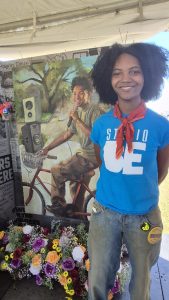
Morrah Be in front of her painting of La Reezy. Photo by Michael Allen Zell
Curious minds wanted to know who would be the featured subject as the Eternal Flowers painting for Jazz Fest Week Two. Guess what? It’s unveiled and… La Reezy was painted by Morrah Be. The young artist said, “Every year, Eternal Seeds has a tradition called Eternal Flowers, where we give the flowers to some of our cultural bearers in the city while they’re still living. This is my part of the contribution. Because I’m a younger and up-and-coming artist, I did an up-and-coming artist rapper in the city, La Reezy. This is all about a celebration of Uptown. He’s riding his bike. He has his speakers. To give homage to hip hop. That’s kind of what the painting is about. He wanted me to express happiness.”
What to say about the incomparable Dianne Reeves, a five-time Grammy-winning vocalist who toured with Harry Belafonte in the ’80s, performed at the Olympics, and has been celebrated for decades? Well, she kicked off with “What’s New?” both a song and a greeting with an added lyric, “I prayed so hard that it wouldn’t rain today.” Also, it was great to see the Brazilian guitarist Romero Lubambo on stage, who has collaborated greatly with the masterful singer. The full band was, of course, as top-notch as it gets, but the interplay between Reeves and Lubambo was especially sublime.
—Michael Allen Zell
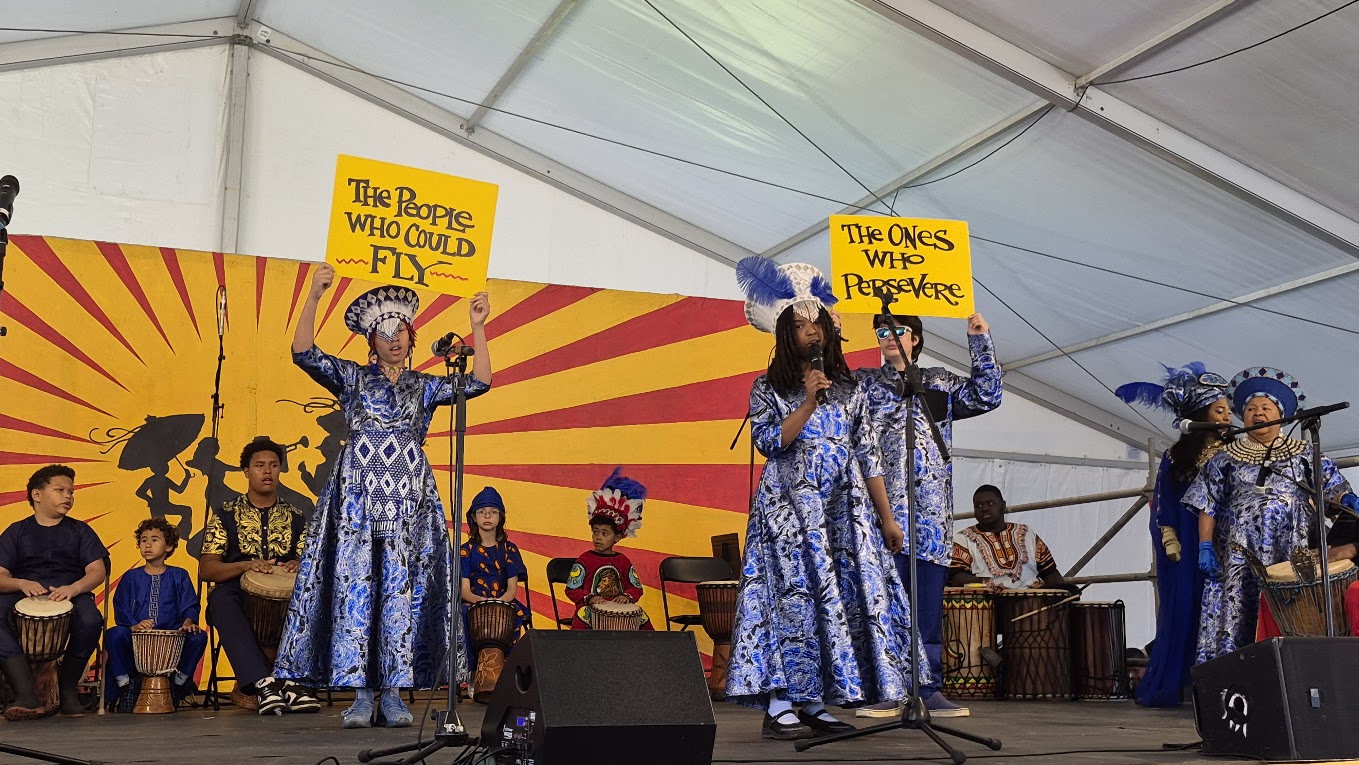
The Guardians Institute. Photo by Michael Allen Zell.