Brett Milano, John Wirt and Michael Allen Zell reviews from Jazz Fest Day 8, Sunday, May 3, 2026.
For those of us who couldn’t get into the Meters reunion (thank you and suck eggs, Live Nation), George Porter Jr’s set with the Runnin’ Partners wasn’t merely the next best thing—it was another chance to see the man and the band who’ve done the most to carry on the Meters groove over the past three decades. The synchrony with his current band (drummer Terrence Houston, keyboardist Michael Lemmler, and guitarist Chris Adkins) gets damn close to the original when they do a Meters song, but they also have a trick bag of their own. On Sunday that included a jazz instrumental, a medley of New Orleans R&B standards (“Oo Poo Pah Doo” and “Don’t You Just Know It”) and an old standby, the soca-styled “Happy Song.” While many of the lyrics sang the praises of the funk, there was also the strongest topical song we’ve yet heard Porter do, “Police State.” It was among many moments this year which suggested that musicians refraining from speaking out is no longer an option.
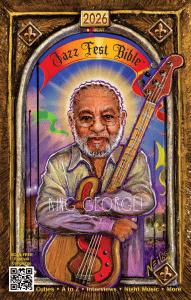
George Porter, Jr. (OffBeat’s Jazz Fest Bible) illustration by Tim Neil
Let me get on my soapbox and say that the Radiators don’t get enough love from Jazz Fest. They’re arguably the most revered rock band this city ever produced, they’ve got fans around the world who come here every January for the anniversary shows, and with Aerosmith retired, the Rads have the longest-running original lineup in all of rock. Plus they can still play a vintage set like the one on Sunday which charged out of the gate with Howlin Wolf’s “44 Blues,” got Southern-soulful on “Lila,” hit a wild Mardi Gras groove on “Pass Out the Hatchets,” jammed gracefully on “River Run,” called down the spirit of Professor Longhair on “Long Hard Journey Home,” and did a few of those indefinable Rads things as well. Put these guys on the poster, for crying out loud.
Herbie Hancock and his former band the Headhunters both played the Fest this year, but there was no reunion. But the Headhunters were very much on Hancock’s mind, as his Jazz Tent set evoked the sound and spirit of that band—and it’s a bit surprising that this late stage of Hancock’s career finds him re-embracing his ’70s fusion phase. At age 86 Hancock’s lost a bit of dexterity, but he’s still got plenty left and can still put a great band together: Sunday’s lineup included New Orleans trumpeter Terence Blanchard, whose fiery playing pushed the whole band forward. There was also a young drummer, Jaylen Petinaud, who evoked Mike Clark’s wild invention in the original Headhunters. Much of the material came from that era, including the reworked “Watermelon Man” and one of fusion’s cornerstone pieces, “Actual Proof” (still done at breakneck speed). Hancock also did a Weather Report classic (“Footprints”) from that era and one of his own earlier standards, the stately “Maiden Voyage.” For the finale he strapped on his old keytar for another Headhunters showpiece, “Chameleon,” dancing this Fest to the finish line.
—Brett Milano
A singer, guitarist and songwriter inspired by classic blues and soul, Marc Stone began Sunday at the Blues Tent with a pair of tradition-based solo acoustic blues songs. These opening numbers conjured a relatively quiet blues storm on a lovely Sunday morning. Stone’s acoustic guitar playing, including slicing lead with a slide, echoed the acoustic blues of Robert Johnson and other foundational bluesman.
A native of New York City, Stone, moved to New Orleans in 1993. A guitar gun for hire for much of the past three decades, his sideman and collaborator credits include the Meters’ Leo Nocentelli, Charles Brown, Eddie Bo and members of the Radiators and Dirty Dozen.
Stone shared with his Jazz Fest audience that he first played at the festival in 1996 and has been a featured performer in the Blues Tent for the past five years. In this decade, he’s focused more on being a front man. He has developed plenty of well-honed skills and his musicianship and songwriting avoid blues and rock clichés.
Bringing his band on stage after his two solo acoustic songs, Stone moved to his Fender Telecaster electric guitar, raising the volume and increasing the musical variety. He and his band, which includes the Japanese-born keyboardist Keiko Komaki, deftly surveyed the blues-rock and Southern rock soundscape. Much of what they do can be classified as that nebulous thing called Americana music. The only downside for Stone’s Sunday Jazz set was the seemingly lengthy time between songs. Lag time of that sort can stall any performer’s on-stage momentum.
The duo of Vicki Peterson and John Cowsill win my vote for best surprise and maybe most fun Jazz Fest show of 2026.
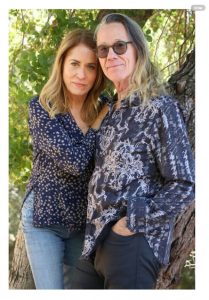
Vicki Peterson and John Cowsill photo courtesy of Henry Diltz
Peterson famously is a member of the all-female 1980s pop-rock band, the Bangles. Cowsill was—can you guess?—was part the 1960s pop-vocal family group, the Cowsills. At Jazz Fest, the married Peterson and Cowsill made beautiful music together. Last year, they released their debut album, Long After the Fire. This year they made their Jazz Fest debut.
From his spot on the Lagniappe Stage, Cowsill made note of the special New Orleans occasion. “This is our first Jazz Fest,” he said. “This is the coolest thing that ever happened.”
Peterson and Cowsill played several songs from Long After the Fire, an entire album of songs composed by Cowsill’s late brothers and bandmates, Bill and Barry. Many of the selections, at least in Peterson and her husband’s bands, have a strong country flavor, including “Embers,” the Bill Cowsill song that inspired the album’s title.
Susan Cowsill, the longtime New Orleans resident who is John Cowsill’s little sister, joined her brother and sister-in-law for “Embers.” That song and the other Long After the Fire tracks they performed were extremely worthy of being recorded, released and performed.
Some of the album’s songs heard Sunday, given their California-country sound, would fit nearly on a 1970s Eagles or Linda Ronsdadt album. Another song, “Is Anybody Here,” a Bill Cowsill and Jeff Hatcher composition in tribute to Roy Orbison, sounded wonderfully like that great singer.
Peterson and John Cowsill also ventured beyond their duo album, playing some hits they released with their other bands. After Peterson sang lead for the Bangles’ Prince-composed “Manic Monday,” John Cowsill took the lead for the Cowsills’ “Hair.” The irrepressible Susan Cowsill, after sneaking on stage several times throughout the show, stayed for the final three songs, the culminating selection being another hit by the Bangles, “Walk Like an Egyptian.”
The late Allen Toussaint was one of those irreplaceable New Orleans talents and personalities the city seemingly couldn’t do without. How can there be a New Orleans without that brilliant pianist, songwriter, arranger, producer and stylish man about town?
New Orleans quite rightly entered a period of mourning following Toussaint’s death at 77 years old in 2015. Nonetheless, the many New Orleans-deep classics and hits he created live on. He was a regular Jazz Fest performer and, Sunday, at the WWOZ Jazz Tent, the Allen Toussaint Jazzity Project celebrated his legacy with a breezy, jazzy take on his music.
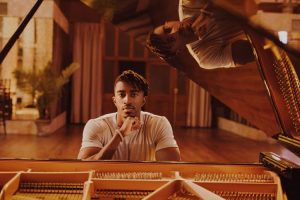
Kyle Roussel. Photo courtesy of the artist.
Toussaint’s 2005 album, Goin’ Places, is the foundation for Sunday’s Jazz fest homage to the New Orleans maestro. The performances’ cast of musicians included Toussaint’s percussionist son, Reginald, grandsons (playing percussion) and longtime drummer and son-in-law, Herman LeBeaux. Kyle Roussel, one a rising younger-generation piano star from New Orleans, stepped into Toussaint’s white socks and sandals, so to speak. Roussel played the part with sparkling, virtuosic expertise.
During a break from the music, Rep. Troy Carter, Louisiana’s congressman from the second congressional district, joined Toussaint’s daughter, Alison Toussaint-LeBeaux, and other family members on stage. Carter praised the late musician and then both he and Toussaint-LeBeaux held up street signs for Allen Toussaint Boulevard, the New Orleans motorway named in Toussaint’s honor in 2022.
A regular at Jazz Fest, clarinetist Tommy Sancton was back again this year to perform with his New Orleans Legacy Band. As always, they played in the Economy Hall tent, the festival’s traditional jazz headquarters.
Sancton was mentored in jazz and clarinet by one of a New Orleans jazz giants, George Lewis. Active in the 1920s, Lewis later became a principal figure in the traditional jazz revival of the 1950s. He also led the Preservation Hall Jazz Band until his death in 1968 at 68 years old.
Sancton was 13 years old when he first heard Lewis at Preservation Hall. The sound Lewis and clarinet produced enthralled him. “I always say his tone was like molten silver,” Sancton told OffBeat in 2019.
Sancton studied clarinet informally with Lewis. He hung around Preservation Hall, too, a white youth in the Jim Crow era learning from black musicians old enough to be his grandfather. He considers them his spiritual grandfathers. Sancton later became a successful journalist and bestselling author, but he also kept tooting, as Pete Fountain would say, his clarinet.
Sancton and his Legacy Band played the expected traditional jazz standards Sunday, such as “Basin Street Blues,” “Panama,” Alphonse Picou’s “High Society” and the Original Dixieland Jass Band’s “Dixieland Jass Band One-Step.” The band included pianist Lars Edegran, bassist Richard Moten, singer-trombonist Freddie Lonzo and drummer Walter Harris, all well-seasoned traditional jazz stalwarts in New Orleans.
Not a flashy group by any means, Sancton’s Legacy Band nonetheless capture and express the buoyant joy that animates early 20th century jazz. And Economy Hall—an intimate performance space by Jazz Fest standards—has a warm and celebratory atmosphere unlike any of other stage at the festival.
—John Wirt
The last day of Jazz Fest is a reckoning. What will be the tone of the day? Was there anything on the list you haven’t eaten yet? How do you want that last memory to be? Especially with beautiful weather handed to us. I decided to go with the irie vibes, which meant Jamaican music whenever possible and finishing the day with headliner Earth, Wind & Fire.
Food choice for the last day was the Cochon de Lait Po Boy, as it was hard to beat the portion and the flavor. Armed with that and a Blackberry Tea, I made my way to the Festival Stage for what became the first of two shows enjoying Jemere Morgan’s reggae music. He came out strong with the powerful “Troddin’,” with the quasi-Biblical line, “Troddin’ through the streets of Babylon.” It soon became clear as he emphasized “The roots will never die” in “Good Old Roots” and spoke on Morgan family heritage before singing “Try Jah Love” (written by Gramps Morgan and Jemere Morgan), that these also felt like commonalities with New Orleans. Add the lyrics of “Neighborhood Girl,” and I was convinced of the universality and connection between Jamaica and the Crescent City. Jemere Morgan is both a songwriter and performer to be reckoned with, and I look forward to his next album.
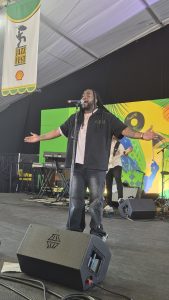
Jemere Morgan. Photo by Michael Allen Zell
Only at Jazz Fest, can you hear within five minutes Jemere Morgan’s rendition of “Night Nurse,” BRW doing Michael Jackson’s “Shake Your Body (Down To The Ground),” and Chere Elise kicking up a Cajun storm. That’s one of the beauties of the fest. Whatever your interest or discovery, it’s all right around the corner from something different, yet it all fits together.
Deacon John & The Ivories have been a top group in New Orleans for several decades. Back in the heydays, they were a highlight of Club Desire in the 9th ward and Uptown’s Dew Drop Inn. Deac was also a major session guitarist, playing on classics like Aaron Neville’s “Tell It Like It Is.” He’s a treasure to the city and beyond. For his set at the WWOZ Jazz Tent, he had a big band, including pianist David Torkanowsky. Even Deac said, “All these horns, whew!” He had wry jokes, a deep songbook, and a veteran’s moxie. “The Best Things In Life Are Free” led into Steely Dan’s “Call Me.” The latter seems an odd choice until the refrain, “Call me Deacon Blue,” with clear multiple meanings in context. Kathleen Moore was right up front on the mic with him, and she particularly shined in her showcase songs “Too Marvelous For Words (Cha Cha)” and “What The World Needs Now.”
Lila Ike has been on the rise, to put it mildly. She stepped onto the Congo Square Stage with “Scatter” from her Treasure Self Love album with the statement, “All my enemies scattered before me.” The lighter “Fry Plantain” with the repeated line, “Fry plantain ‘pon Sunday morning,” hit right, as did when she strapped on a guitar for “Wanted,” a tough social statement. If not for the iconic Earth, Wind & Fire headlining at the same time, I would’ve been curious how her own headlining set in the more intimate Sandals Cultural Exchange Pavilion Stage would’ve gone down.
That spot, mostly referred to by attendees as the Jamaica tent, was indeed the place to catch Jemere Morgan for a second time. The set list was similar to that of his Festival Stage kick-off show, but all was well due to the strength of his songs. He definitely realized the benefit of connecting with the crowd and the response was enthusiastic. The only thing that may have taken his music up a notch would’ve been the addition of a saxophonist rather than the keyboardist playing those particular parts.
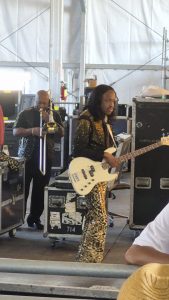
Verdine White of Earth Wind and Fire. Photo by Michael Allen Zell.
Lord knows there were plenty of great sax players around. I ran into Utopia backstage before Rebirth Brass Band brought the house down at the Congo Square Stage, officially (along with DJ Captain Charles) opening for EWF. The randomness of Jazz Fest meetings is always a blessing, and it was also great to see Kala Roy, owner and brain behind the Algiers Music and Artist Studio (AMAS). Roy has been booking great events on Teche St. along with being community-oriented and giving young people a place to thrive. Some New Orleans people fuss about crossing the bridge. Get over that mess. AMAS is worth it.
After a day of excitement and exhaustion, the sparkly-suited Earth, Wind & Fire made the Sunday heat sweet. They opened with “Shining Star” and had a sharp percussive intro to “Serpentine Fire.” Imagine a set list that ends with the trio of “Boogie Wonderland,” “Let’s Groove,” and “September.” They barely scratched the surface of one of the most enduring catalogue of hits in music history. The steps were there. The energy was there. Bassist Verdine White looked like he was having the time of his life. So were we, and with that, it’s a wrap on Jazz Fest 2026. No regrets.
—Michael Allen Zell